It's time for our weekly look-in at the 2016 presidential races. Big wins in New York by the two front runners, Hillary Clinton and Donald Trump, are the key development this week. The key question is whether this translates into nomination gold for them. We'll look first at the Democrats and then the Republicans.
Democrats
Hillary Clinton's 16-point 58 to 42 percent win over Bernie Sanders gave her a delegate edge of 139 to 106 in the Empire State. That lengthens her delegate lead by 33 in the race for the nomination. In the overall count of pledged delegates won in primaries and caucuses she now has 1428 to his 1151. There are 1472 pledged delegates left to win in the states that haven't voted yet. A total of 2026 secures the majority, so Hillary would need 598 of those, about 40.5%. Bernie would have to win 875, about 59.5%. He'd have to win the remaining contests by an average of 19 points to overtake Hillary. Is that possible?
To find out, let's look at what's coming up in next Tuesday's votes. Five Northeastern states will be in play on April 26, all holding primaries. All Democratic contests award delegates proportionally to the vote. So, does the Bern look to have a good chance to do some catching up? Well, if the polls are anything close to accurate, not so much. Pennsylvania is the big prize, 189 delegates. Hillary leads there by 16 points in the average of recent polling. Maryland offers 95 delegates, with Hillary up by 21. Connecticut has 55 and Hillary leads there by an average of 7. Then you have two small states with only one recent poll in each. Rhode Island has 24 delegates and the one survey there had Clinton up by 9. Delaware will send 21 delegates to the convention in Philadelphia, and the one poll taken there this month showed Hillary ahead by 7. If these polls are right, and most recent polling this primary season has had good accuracy, the former Secretary of State will win 219 delegates next Tuesday and the Vermont Senator will pick up 165. That means another 54 added to Clinton's lead.
So it's looking more and more that the Democratic nomination is effectively wrapped up. After those results next Tuesday, Sanders would have to win all the remaining races by an average of almost 30 points to catch up in pledged delegates. And if you add in the super delegates it's even more certain. Hillary has the support of 502 to Bernie's 38, with 172 still undeclared. With them counted into the mix Bernie would need a whopping 72 percent of all the still unchosen delegates to win at the convention. The bottom line? It's all over but the shouting. Hillary Clinton is the 2016 Democratic nominee.
Republicans
On the GOP side the main question is whether Donald Trump can clinch the nomination on the first ballot of the Cleveland convention. After taking 60 percent of the vote in his home state to 25 for John Kasich and 15 for Ted Cruz, Trump walked away with 89 delegates to Kasich's 3. He now has 845, followed by Cruz with 559, Marco Rubio, who has suspended his campaign, with 171, and Kasich with 148. Trump needs 1237 for a first-ballot convention triumph and there are 674 Republican delegates still to be awarded in the upcoming states. That means The Donald would need to get 392 of them, a little over 58 percent. Is that doable? Well, it looks like it's going to be very close one way or the other. He could just make it or could fall just short. Complicating matters are the varied and sometimes bizarre delegate selection formulas used by Republican parties in the different states.
Here's how things stand in the five April 26 Republican primaries. Pennsylvania has 71 delegates and the polls say Trump 44, Cruz 25, Kasich 24. Maryland gets 38 and the race is similar to Pennsylvania's, Trump 41, Kasich 26 and Cruz 25. Connecticut, 28 delegates, has Trump at 49, Kasich 27 and Cruz 18. Then come Rhode Island and Delaware, with only one poll each, as with the Dems. RI has 19 delegates and the one poll from February gave Trump 43 with Cruz and 10 and Kasich at 14. Rubio had 25 percent support back then. Delaware has 16 delegates and the one April poll showed a big lead for Trump: 55 to 18 for Kasich and 15 for Cruz. In terms of delegates, as near as I can figure given the different rules in play in each state, Trump stands to win 71 delegates, Cruz 12 and Kasich 18.
Then there are 54 delegates to be elected in Pennsylvania's 18 congressional districts, three per district, who are winner take all by district, but who are not bound to vote for the winning candidate of their district once they get to the convention. Talk about strange. Depending on who those delegates are and how they are selected, they could vote for anybody even if Trump wins their district. And judging from the polling there, one would expect Trump to win most of those districts. But GOP insiders do not have much love for Trump, so who knows what they might do if Trump's campaign apparatus can't insure their supporters occupy those seats. If they can, Trump would come away with 105 delegates next Tuesday to Cruz's 22 and Kasich's 28.That would leave Trump at 950 delegates, needing 287 more to get to the magic number with 539 still to be elected in the remaining states. That outcome would bring Trump's needed percentage to clinch down to 53.2%, seemingly a doable feat, especially considering he is running 9 points ahead in delegate-rich California, which awards most of its delegates to congressional district winners on a winner-take all basis. But if the insider game denies him those votes, he would need 63 percent of the rest of the unchosen delegates to win on the first ballot in Cleveland, a much taller order. The bottom line on the Republican side is that it's nip and tuck and could go either way. It should be pretty dramatic to watch.
Showing posts with label Republican Primaries 2016. Show all posts
Showing posts with label Republican Primaries 2016. Show all posts
Thursday, April 21, 2016

Saturday, March 26, 2016
Trump and Cruz Reach New Lows
How repugnant is Donald Trump? Here's a quote about Trump from conservative pundit David Brooks from a discussion on PBS News Hour.
It’s just mind-boggling. And we have sort of become acculturated, because this campaign has been so ugly. We have become acculturated to sleaze and unhappiness that you just want to shower from every 15 minutes.
The Trump comparison of the looks of the wives, he does have, over the course of his life, a consistent misogynistic view of women as arm candy, as pieces of meat. It’s a consistent attitude toward women which is the stuff of a diseased adolescent.
And so we have seen a bit of that show up again. But if you go back over his past, calling into radio shows bragging about his affairs, talking about his sex life in public, he is childish in his immaturity. And his — even his misogyny is a childish misogyny.
And that’s why I do not think Republicans, standard Republicans, can say, yes, I’m going to vote for this guy because he’s our nominee. He’s of a different order than your normal candidate. And this whole week is just another reminder of that.
And how feckless is Ted Cruz? Responding to Trump ridiculing the looks of his wife, Cruz said he was angry and told the Donald to "leave Heidi alone." He rightly called the mogul a "sniveling coward" and "sleazy Donald." So far, so good. But then when a reporter asked him if that meant he would not support or vote for Trump if he were the Republican nominee, Cruz dodged the question by saying he didn't think Trump would be the nominee. Asked again, he again dodged. That's been the central dilemma of the anti-Trumps all along. Even if they have the guts to call him a scumbag, they know they'll need his racist, misogynist, xenophobic supporters to win if they manage to wrest the GOP nomination from him, and they don't want to alienate them. That means, of course, that candidates like Cruz play into Trump's narrative (they're all weak) when they then don't stand up and say, no I won't vote for a sleazy, sniveling coward. Cruz is either admitting that his critique is hyperbole or that he doesn't have the guts to say no to a "diseased adolescent," as Brooks put it. The spectacle becomes tawdrier by the day. Does anyone really think either of these two is fit to be president or could win a national political election?
It’s just mind-boggling. And we have sort of become acculturated, because this campaign has been so ugly. We have become acculturated to sleaze and unhappiness that you just want to shower from every 15 minutes.
The Trump comparison of the looks of the wives, he does have, over the course of his life, a consistent misogynistic view of women as arm candy, as pieces of meat. It’s a consistent attitude toward women which is the stuff of a diseased adolescent.
And so we have seen a bit of that show up again. But if you go back over his past, calling into radio shows bragging about his affairs, talking about his sex life in public, he is childish in his immaturity. And his — even his misogyny is a childish misogyny.
And that’s why I do not think Republicans, standard Republicans, can say, yes, I’m going to vote for this guy because he’s our nominee. He’s of a different order than your normal candidate. And this whole week is just another reminder of that.
And how feckless is Ted Cruz? Responding to Trump ridiculing the looks of his wife, Cruz said he was angry and told the Donald to "leave Heidi alone." He rightly called the mogul a "sniveling coward" and "sleazy Donald." So far, so good. But then when a reporter asked him if that meant he would not support or vote for Trump if he were the Republican nominee, Cruz dodged the question by saying he didn't think Trump would be the nominee. Asked again, he again dodged. That's been the central dilemma of the anti-Trumps all along. Even if they have the guts to call him a scumbag, they know they'll need his racist, misogynist, xenophobic supporters to win if they manage to wrest the GOP nomination from him, and they don't want to alienate them. That means, of course, that candidates like Cruz play into Trump's narrative (they're all weak) when they then don't stand up and say, no I won't vote for a sleazy, sniveling coward. Cruz is either admitting that his critique is hyperbole or that he doesn't have the guts to say no to a "diseased adolescent," as Brooks put it. The spectacle becomes tawdrier by the day. Does anyone really think either of these two is fit to be president or could win a national political election?
Monday, March 14, 2016
March 15 Primaries: What to Look For
Five populous states rich in delegates will be up for grabs in tomorrow's March 15 primary contests. The main question to be answered in these important primaries is whether the Democratic and Republican challengers can blunt the momentum of front runners Hillary Clinton and Donald Trump in their respective races. We'll start with the Democrats first.
Democrats
Hillary Clinton starts with a 215-delegate lead among pledged delegates elected so far, 766 to 551. Among the roughly 700 superdelegates, who can vote for whomever they wish, she has been endorsed so far by 461 while only 25 have have declared they are backing Bernie Sanders. Sanders's strategy thus has to be to win states by convincing enough margins that he overcomes Clinton's pledged delegate lead and also makes superdelegates change their minds.
North Carolina has 107 delegates at stake. Polls show Clinton ahead by an average of 24 points, 57 to 33 percent. Her lead has been shrinking, so let me generously (for Bernie) project that she holds on by a narrow 52-48 margin. That would give Hillary 56 delegates and Bernie 51.
Florida has a trove of 214 delegates. Clinton is way ahead in all polls. Her average lead is 29 points, 61 percent to 32. If we give Bernie all the undecideds and call the outcome 60-40 for Hillary, she will come home with 128 delegates and he will get 86.
Ohio sends 143 delegates to the Democratic convention in Philadelphia. Polls have Clinton up by an average of 8 points, 51 to 43. Her lead has been shrinking, so let's suppose Sanders nips her at the wire and wins by an eyelash. Call it 72 delegates for the Bern, 71 for Hillary.
Illinois elects 156 Democratic delegates. Polls show a virtual dead heat, with the Secretary up by 48-46 over the Senator. Again, momentum is moving Sanders's way, so we'll project another buzzer beater win for the Vermonter: 79 delegates to 77.
Missouri chooses 71 delegates. It's another state in which polls give Clinton a narrow lead, 46-43 in this case. Once again, let's presume the challenger closes the gap and ekes out a victory, 36 delegates to 35.
The end of all this, which I've shaded toward Sanders in every case, is two wins for Clinton, one of them solid, and three close wins for Sanders. The important factor is that Hillary has her biggest lead in the biggest state with the most delegates, Florida. The end of all this results in 367 delegates won for her and 324 delegates won for him. Hillary stands to increase her lead by around 43 delegates, giving her 1133 pledged delegates to Bernie's 875 by the end of the night. With 4,000 total pledged delegates to be won by the end of the primary season, this means Sanders would need to win 1,126 of the 1,992 delegates in the remaining primaries and caucuses to catch up. That means winning every state by an average of 56.5% to 43.5%, a 13-point margin. That is, frankly, a very tall order. If you add in the superdelegates, she will be ahead 1594 to 900, and would need only 788 of the 2270 delegates of both types to win the nomination. That's only 35 percent. So, unless there is a severe collapse in Clinton's support, she has to be considered the prohibitive favorite to be the nominee. On election night, watch the returns from North Carolina first, then Florida. If North Carolina is going Bernie's way, the miracle for him could be happening. If Clinton isn't rolling up a big margin in Florida it portends major problems for her in the states that report in later. But if they are going according to form, Hillary Clinton will be one step closer to the Democratic nomination.
Republicans
Donald Trump has a 90-delegate lead on Ted Cruz, his closest pursuer. Marco Rubio and John Kasich trail farther behind. The current count is Trump 460, Cruz 370, Rubio 163 and Kasich 63. That gives Trump 44% of the delegates awarded so far, tantalizingly close to the 50 percent pace he needs to secure the nomination on the first ballot. The clear leader in four of the five states at issue, he stands a good chance to add to that percentage when the votes are counted from this next round.
North Carolina offers 72 GOP delegates. Trump enjoys a 12-point polling margin on Cruz there 41-29, with Kasich (11) and Rubio (9) being non-factors. Prediction: 35 delegates for Trump, 28 for Cruz, 5 for Kasich and 4 for Rubio.
Florida has 99 delegates on the table, and the state is winner take all. It's do or die for Rubio in his home state, and it's not looking good for him. Average surveys have Trump at 43, Rubio at 24, Cruz with 19 and Kasich at 9. Chalk up 99 delegates for the Donald.
Ohio has 66 at stake and it's also winner take all. As with Rubio in Florida, it's win or go home for John Kasich in the Buckeye state. But this time, it looks like Ohio Republicans are turning to their home state governor. It's still close: surveys give Kasich an average of 38 to Trump's 34, but the trend has been moving his way, so I'll predict a Kasich win. Besides, if he doesn't the race is practically over. So 66 delegates for John Kasich.
Illinois has 69 delegates, to be distributed proportionally. Polls say Trump 35, Cruz 26, Cruz 18 and Rubio 13. If that's how it comes down Trump will win 28, Cruz 21, Kasich 12 and Rubio 8.
Missouri wraps up the day's voting with 52 delegates. It has a GOP allotment process that I'll call "winner take most." There's only been one poll there, and it shows Trump 36 percent, Cruz 29, Rubio 9 and Kasich 8. If that is accurate Trump will win 36 delegates and Cruz will take in 16.
Four wins for the night for Trump would give him 198 of the 358 delegates at stake. Kasich, thanks primarily to winning Ohio, would get 83. Cruz would add 65 and Rubio 12. The standings at the end of the day would read Trump 658, Cruz 435, Rubio 175 and Kasich 146. With 1,058 delegates left in the contests ahead, Trump would need 579 to lock down the nomination, 54.7% of all those still to be won. Rubio would likely have to exit the race after losing Florida, leaving Kasich as the remaining conventional Republican hope. There are still several winner take all contests left, especially the big prize of California. Unless Cruz can pull some unexpected upsets in places like Missouri, North Carolina and Illinois, the Trump train appears on track to steam its way to the nomination at Cleveland. And if Kasich doesn't win Ohio, that will become almost inevitable.
Democrats
Hillary Clinton starts with a 215-delegate lead among pledged delegates elected so far, 766 to 551. Among the roughly 700 superdelegates, who can vote for whomever they wish, she has been endorsed so far by 461 while only 25 have have declared they are backing Bernie Sanders. Sanders's strategy thus has to be to win states by convincing enough margins that he overcomes Clinton's pledged delegate lead and also makes superdelegates change their minds.
North Carolina has 107 delegates at stake. Polls show Clinton ahead by an average of 24 points, 57 to 33 percent. Her lead has been shrinking, so let me generously (for Bernie) project that she holds on by a narrow 52-48 margin. That would give Hillary 56 delegates and Bernie 51.
Florida has a trove of 214 delegates. Clinton is way ahead in all polls. Her average lead is 29 points, 61 percent to 32. If we give Bernie all the undecideds and call the outcome 60-40 for Hillary, she will come home with 128 delegates and he will get 86.
Ohio sends 143 delegates to the Democratic convention in Philadelphia. Polls have Clinton up by an average of 8 points, 51 to 43. Her lead has been shrinking, so let's suppose Sanders nips her at the wire and wins by an eyelash. Call it 72 delegates for the Bern, 71 for Hillary.
Illinois elects 156 Democratic delegates. Polls show a virtual dead heat, with the Secretary up by 48-46 over the Senator. Again, momentum is moving Sanders's way, so we'll project another buzzer beater win for the Vermonter: 79 delegates to 77.
Missouri chooses 71 delegates. It's another state in which polls give Clinton a narrow lead, 46-43 in this case. Once again, let's presume the challenger closes the gap and ekes out a victory, 36 delegates to 35.
The end of all this, which I've shaded toward Sanders in every case, is two wins for Clinton, one of them solid, and three close wins for Sanders. The important factor is that Hillary has her biggest lead in the biggest state with the most delegates, Florida. The end of all this results in 367 delegates won for her and 324 delegates won for him. Hillary stands to increase her lead by around 43 delegates, giving her 1133 pledged delegates to Bernie's 875 by the end of the night. With 4,000 total pledged delegates to be won by the end of the primary season, this means Sanders would need to win 1,126 of the 1,992 delegates in the remaining primaries and caucuses to catch up. That means winning every state by an average of 56.5% to 43.5%, a 13-point margin. That is, frankly, a very tall order. If you add in the superdelegates, she will be ahead 1594 to 900, and would need only 788 of the 2270 delegates of both types to win the nomination. That's only 35 percent. So, unless there is a severe collapse in Clinton's support, she has to be considered the prohibitive favorite to be the nominee. On election night, watch the returns from North Carolina first, then Florida. If North Carolina is going Bernie's way, the miracle for him could be happening. If Clinton isn't rolling up a big margin in Florida it portends major problems for her in the states that report in later. But if they are going according to form, Hillary Clinton will be one step closer to the Democratic nomination.
Republicans
Donald Trump has a 90-delegate lead on Ted Cruz, his closest pursuer. Marco Rubio and John Kasich trail farther behind. The current count is Trump 460, Cruz 370, Rubio 163 and Kasich 63. That gives Trump 44% of the delegates awarded so far, tantalizingly close to the 50 percent pace he needs to secure the nomination on the first ballot. The clear leader in four of the five states at issue, he stands a good chance to add to that percentage when the votes are counted from this next round.
North Carolina offers 72 GOP delegates. Trump enjoys a 12-point polling margin on Cruz there 41-29, with Kasich (11) and Rubio (9) being non-factors. Prediction: 35 delegates for Trump, 28 for Cruz, 5 for Kasich and 4 for Rubio.
Florida has 99 delegates on the table, and the state is winner take all. It's do or die for Rubio in his home state, and it's not looking good for him. Average surveys have Trump at 43, Rubio at 24, Cruz with 19 and Kasich at 9. Chalk up 99 delegates for the Donald.
Ohio has 66 at stake and it's also winner take all. As with Rubio in Florida, it's win or go home for John Kasich in the Buckeye state. But this time, it looks like Ohio Republicans are turning to their home state governor. It's still close: surveys give Kasich an average of 38 to Trump's 34, but the trend has been moving his way, so I'll predict a Kasich win. Besides, if he doesn't the race is practically over. So 66 delegates for John Kasich.
Illinois has 69 delegates, to be distributed proportionally. Polls say Trump 35, Cruz 26, Cruz 18 and Rubio 13. If that's how it comes down Trump will win 28, Cruz 21, Kasich 12 and Rubio 8.
Missouri wraps up the day's voting with 52 delegates. It has a GOP allotment process that I'll call "winner take most." There's only been one poll there, and it shows Trump 36 percent, Cruz 29, Rubio 9 and Kasich 8. If that is accurate Trump will win 36 delegates and Cruz will take in 16.
Four wins for the night for Trump would give him 198 of the 358 delegates at stake. Kasich, thanks primarily to winning Ohio, would get 83. Cruz would add 65 and Rubio 12. The standings at the end of the day would read Trump 658, Cruz 435, Rubio 175 and Kasich 146. With 1,058 delegates left in the contests ahead, Trump would need 579 to lock down the nomination, 54.7% of all those still to be won. Rubio would likely have to exit the race after losing Florida, leaving Kasich as the remaining conventional Republican hope. There are still several winner take all contests left, especially the big prize of California. Unless Cruz can pull some unexpected upsets in places like Missouri, North Carolina and Illinois, the Trump train appears on track to steam its way to the nomination at Cleveland. And if Kasich doesn't win Ohio, that will become almost inevitable.
Friday, March 4, 2016
The Meaning of Super Tuesday
The March 1 "Super Tuesday" presidential election contests clarified matters for both parties, putting Hillary Clinton in the driver's seat for the Democratic nomination and giving Donald Trump the inside track for the Republican nomination. By itself, Super Tuesday didn't clinch things for either front-runner. But it did make things a whole lot tougher for the pursuers. Both races are like a football game with one team 21 points ahead at halftime. We'll look first at the Democrats and then the Republicans. If you want more, here's a link to an excellent Wall Street Journal spread on the delegate race and the upcoming calendar.
Democrats Hillary Clinton did well on Super Tuesday. She captured 7 states and 504 delegates. Bernie Sanders took 4 states and 340 delegates. Clinton thus increased her delegate lead by 164. She now has earned 599 pledged delegates to Bernie Sanders's 407, a margin of 192. There will be about 4,000 pledged delegates at the convention, so to secure a majority of them in Philadelphia Secretary Clinton would need to win 1402 of the remaining 3000 to be elected, or 47% of them. Senator Sanders would need 1594, or 53%. So, since in the Democratic contest there are no "winner take all" primaries, it would seem Sanders is definitely still in the race. He would need to consistently outperform Clinton by about 6% from now on to win.
But then there are the "Superdelegates." These are about 700 Democratic elected officials who automatically also get a vote at the convention. They can vote for whomever they wish, unlike pledged delegates elected in primaries or in the voter caucuses who are obligated to vote for the candidate they were elected to represent on the first ballot at the convention. About 70% of these superdelegates have already committed to a candidate; 457 of them have said they will be voting for Hillary Clinton and only 22 have declared for Bernie Sanders. If you add the supers in with the primary delegates, Clinton now has 1056 convention delegates and Sanders has just 429. It's going to take 2,383 delegates (of the 4775 at the convention) to get the nomination. So that means there are 3290 delegates left. With 1056 already in her tote bag, Clinton needs only 1,327 of them to secure the nomination. That's just 41%. Bernie Sanders would need 1,954, or 59% to clinch. Winning by an average of 6% in every contest would be difficult but conceivable. But winning primary after primary by an average of 18% is a near impossibility. Given this reality, a Sanders nomination is a real longshot.
To look a little more closely, Clinton won in blowout fashion across the South, carrying the six states of Georgia, Virginia, Alabama, Tennessee, Arkansas and Texas all by better than two to one majorities. She also took an upset win in Massachusetts, edging Sanders there by 1 %. The four states Sanders won were by solid margins: Oklahoma by 10 points, his home state of Vermont in a 72-point landslide, and caucuses by 24 points in Minnesota and 19 in Colorado. So does that mean that since most of the remaining states won't be in the South that Bernie has a great chance to catch up? Well, not if the polls are right. Clinton's average lead in polls of the March 8 Michigan primary is 17%. She is up by an average of 24 points in Florida and 15 points in Ohio for those two March 15 contests. Those are big states with lots of delegates. Sanders needs to make up a lot of ground in less than two weeks or his chances will evaporate. Unless the FBI investigation of her e-mail problems mortally wounds the former Secretary of State, it appears her message of experience, detailed policy proposals and her strength with women and minorities will carry her through to victory and the Democratic nomination.
Republicans Donald Trump had a very good night on Super Tuesday. Like Clinton, he won 7 states, in the process taking 221 delegates of the 523 at stake. Ted Cruz had a good night too. The Texas Senator won three states and garnered 195 delegates. Florida Senator Marco Rubio remained relevant, winning one state and 85 delegates. Ohio Governor John Kasich got 19 delegates and retired neurosurgeon Ben Carson got 3 before dropping out of the race. There will be 2,473 delegates at the Republican convention in Cleveland, with 1237 needed to win. In the overall race Trump now has 319 delegates, Cruz 226, Rubio 110 and Kasich 25. Carson has 8 and Jeb Bush has 3. That means about 690 delegates have been allotted. There are still about 1783 still to be won.
To get to 1237 Trump would need 918 of those 1783, a little over 51%. That certainly seems to be a reasonable prospect for his candidacy. It becomes even more probable given a unique feature of the GOP nomination process. They don't have superdelegates, but they do have some "winner take all" primaries. These include some big states with major delegate hauls up for grabs. On March 15 Florida will offer a 99-delegate winner-take-all contest and Ohio will have 66-delegate prize. Those states are assuming a "do or die" level of importance for Marco Rubio and John Kasich, respectively. If Rubio gets shut out in his home state of Florida it's hard to see a credible victory scenario for him going forward. He's only won one state, Minnesota, and that was a caucus. If anything, Kasich is even more dependent on winning his home state of Ohio. Though he came close to beating Trump in Vermont, Kasich has yet to score a win in 2016. Victory in Ohio is the only realistic way he can establish his viability and set up chances to contend in other nearby Great Lakes states such as Pennsylvania, Indiana and Wisconsin.
Looking more closely at Tuesday's results, Trump was the only candidate who showed solid popularity across the board. He won substantial pluralities in the Southern states of Georgia, Alabama and Tennessee, and ran up a lopsided plurality in Massachusetts. He narrowly edged out Cruz in Arkansas, Rubio in Virginia and Kasich in Vermont. Trump came in second everywhere he didn't win except Minnesota. Cruz won a 6-point victory in Oklahoma, a 16-point triumph in Texas and a 2-point squeaker in the Alaska caucuses. He came in second in Alabama, Tennessee, Arkansas and Minnesota. Rubio managed his first win by 8 points in the Minnesota caucuses and came in second in Georgia, Virginia and Massachusetts. So the good news for Trump is that his muscular persona and positions seem to have adherents throughout the GOP electorate. Cruz is strong with evangelicals and does well in conservative areas. Rubio is the current establishment hope, and Kasich seeks to become that. He has certainly cornered the market on being the picture of the mature, responsible candidate in this group. The anti-Trump candidates can take heart in the knowledge that the mogul has yet to crack 50% in any of these contests. Yet even so, they still have to beat him, and the polls offer little cause for optimism. Polls give the New York businessman a 17-point lead in Michigan and 24 in Mississippi, which vote Tuesday, March 8. He's up by 18 in Florida's March 15 primary, and has a narrow 5-point lead on Kasich in Ohio, which will be decided on the same day. The next couple of weeks should tell the tale. It could be down to Trump and Cruz, with Trump the prohibitive favorite, 10 days from today.
Democrats Hillary Clinton did well on Super Tuesday. She captured 7 states and 504 delegates. Bernie Sanders took 4 states and 340 delegates. Clinton thus increased her delegate lead by 164. She now has earned 599 pledged delegates to Bernie Sanders's 407, a margin of 192. There will be about 4,000 pledged delegates at the convention, so to secure a majority of them in Philadelphia Secretary Clinton would need to win 1402 of the remaining 3000 to be elected, or 47% of them. Senator Sanders would need 1594, or 53%. So, since in the Democratic contest there are no "winner take all" primaries, it would seem Sanders is definitely still in the race. He would need to consistently outperform Clinton by about 6% from now on to win.
But then there are the "Superdelegates." These are about 700 Democratic elected officials who automatically also get a vote at the convention. They can vote for whomever they wish, unlike pledged delegates elected in primaries or in the voter caucuses who are obligated to vote for the candidate they were elected to represent on the first ballot at the convention. About 70% of these superdelegates have already committed to a candidate; 457 of them have said they will be voting for Hillary Clinton and only 22 have declared for Bernie Sanders. If you add the supers in with the primary delegates, Clinton now has 1056 convention delegates and Sanders has just 429. It's going to take 2,383 delegates (of the 4775 at the convention) to get the nomination. So that means there are 3290 delegates left. With 1056 already in her tote bag, Clinton needs only 1,327 of them to secure the nomination. That's just 41%. Bernie Sanders would need 1,954, or 59% to clinch. Winning by an average of 6% in every contest would be difficult but conceivable. But winning primary after primary by an average of 18% is a near impossibility. Given this reality, a Sanders nomination is a real longshot.
To look a little more closely, Clinton won in blowout fashion across the South, carrying the six states of Georgia, Virginia, Alabama, Tennessee, Arkansas and Texas all by better than two to one majorities. She also took an upset win in Massachusetts, edging Sanders there by 1 %. The four states Sanders won were by solid margins: Oklahoma by 10 points, his home state of Vermont in a 72-point landslide, and caucuses by 24 points in Minnesota and 19 in Colorado. So does that mean that since most of the remaining states won't be in the South that Bernie has a great chance to catch up? Well, not if the polls are right. Clinton's average lead in polls of the March 8 Michigan primary is 17%. She is up by an average of 24 points in Florida and 15 points in Ohio for those two March 15 contests. Those are big states with lots of delegates. Sanders needs to make up a lot of ground in less than two weeks or his chances will evaporate. Unless the FBI investigation of her e-mail problems mortally wounds the former Secretary of State, it appears her message of experience, detailed policy proposals and her strength with women and minorities will carry her through to victory and the Democratic nomination.
Republicans Donald Trump had a very good night on Super Tuesday. Like Clinton, he won 7 states, in the process taking 221 delegates of the 523 at stake. Ted Cruz had a good night too. The Texas Senator won three states and garnered 195 delegates. Florida Senator Marco Rubio remained relevant, winning one state and 85 delegates. Ohio Governor John Kasich got 19 delegates and retired neurosurgeon Ben Carson got 3 before dropping out of the race. There will be 2,473 delegates at the Republican convention in Cleveland, with 1237 needed to win. In the overall race Trump now has 319 delegates, Cruz 226, Rubio 110 and Kasich 25. Carson has 8 and Jeb Bush has 3. That means about 690 delegates have been allotted. There are still about 1783 still to be won.
To get to 1237 Trump would need 918 of those 1783, a little over 51%. That certainly seems to be a reasonable prospect for his candidacy. It becomes even more probable given a unique feature of the GOP nomination process. They don't have superdelegates, but they do have some "winner take all" primaries. These include some big states with major delegate hauls up for grabs. On March 15 Florida will offer a 99-delegate winner-take-all contest and Ohio will have 66-delegate prize. Those states are assuming a "do or die" level of importance for Marco Rubio and John Kasich, respectively. If Rubio gets shut out in his home state of Florida it's hard to see a credible victory scenario for him going forward. He's only won one state, Minnesota, and that was a caucus. If anything, Kasich is even more dependent on winning his home state of Ohio. Though he came close to beating Trump in Vermont, Kasich has yet to score a win in 2016. Victory in Ohio is the only realistic way he can establish his viability and set up chances to contend in other nearby Great Lakes states such as Pennsylvania, Indiana and Wisconsin.
Looking more closely at Tuesday's results, Trump was the only candidate who showed solid popularity across the board. He won substantial pluralities in the Southern states of Georgia, Alabama and Tennessee, and ran up a lopsided plurality in Massachusetts. He narrowly edged out Cruz in Arkansas, Rubio in Virginia and Kasich in Vermont. Trump came in second everywhere he didn't win except Minnesota. Cruz won a 6-point victory in Oklahoma, a 16-point triumph in Texas and a 2-point squeaker in the Alaska caucuses. He came in second in Alabama, Tennessee, Arkansas and Minnesota. Rubio managed his first win by 8 points in the Minnesota caucuses and came in second in Georgia, Virginia and Massachusetts. So the good news for Trump is that his muscular persona and positions seem to have adherents throughout the GOP electorate. Cruz is strong with evangelicals and does well in conservative areas. Rubio is the current establishment hope, and Kasich seeks to become that. He has certainly cornered the market on being the picture of the mature, responsible candidate in this group. The anti-Trump candidates can take heart in the knowledge that the mogul has yet to crack 50% in any of these contests. Yet even so, they still have to beat him, and the polls offer little cause for optimism. Polls give the New York businessman a 17-point lead in Michigan and 24 in Mississippi, which vote Tuesday, March 8. He's up by 18 in Florida's March 15 primary, and has a narrow 5-point lead on Kasich in Ohio, which will be decided on the same day. The next couple of weeks should tell the tale. It could be down to Trump and Cruz, with Trump the prohibitive favorite, 10 days from today.
Saturday, January 30, 2016
Iowa GOP Caucuses: Two Days, Two Questions
Two days out from the Iowa Caucuses there are two main questions to be settled on the Republican side: First, can anybody stop Donald Trump, and second, who will emerge as the "establishment" challenger? The answer to the first is probably not. The answer to the second is likely Marco Rubio. The one thing to keep in mind is that Iowa's Republican caucusers have proven to be truly unpredictable. The political world was shocked when Mike Huckabee came in first in 2008 and Rick Santorum took Hawkeye State laurels in 2012. Both rode those to several state wins and respectable second place finishes in the nomination process. With that caveat out of the way, here's how things stand.
According to an average of state polls of likely GOP caucus goers there are only four candidates with significant support. Trump is at 31%, Ted Cruz 25, Rubio 15 and Ben Carson 9. Jeb Bush is next, but has only 4 percent. The trends are important. Trump stalled for quite awhile but has gained about 5 points the past two weeks. Cruz peaked about three weeks ago with a 4-point lead over Trump but has been edging downward since. Carson led at Halloween and slid enormously until stabilizing at his current level for the past few weeks. Rubio has surged 5 points in the past week.
So what does this portend? Cruz pretty badly could use a win here. It's a state well-suited to his demographics with a big Evangelical population. If Cruz doesn't get the momentum of a win here it's hard to see him winning anywhere anytime soon, maybe until Texas on Super Tuesday, March 1. But by then he may be on the severe downswing. No one is quite sure about Trump's turnout machine, so a Cruz win must be considered a possibility. Rubio wins if he finishes third, which it looks pretty strongly like he will. That positions him as the top establishment alternative to the unorthodox Trump and the anti-party Cruz. Carson hardly stays relevant after these caucuses. Expect to see his supporters continue to drift away. Many of them could go to Cruz, but Rubio's been making a play for Carson's religious-oriented backers of late.
One thing is almost certain: Iowa will produce a surprise; it always does. Either Cruz will beat Trump or one of the seeming also-rans (Bush, Chris Christie, John Kasich, Rand Paul, Carly Fiorina Mike Huckabee or Rick Santorum) will do much better than anticipated and be given a new lease on political life for the time being.
Next week is the New Hampshire Primary. The Tuesday, February 9 vote is mixed, that is, people will be able to vote in either primary's party regardless of their registration. Among those saying they're likely to vote in the New Hampshire Republican contest it's currently no contest for first place, with Trump pulling in 31% in polling averages. He's followed by Kasich at 13, Cruz at 12 and Bush at 11. Rubio has 9 and Christie comes in at 7. That's why Kasich, Bush and Christie will hang in there no matter how badly they do in Iowa--they're all considerably more popular in the Northeast than the farm belt.
But after that the field should winnow considerably. Cruz is the only one within shouting distance of Trump in South Carolina and Nevada, where the campaign moves the next two weeks, and it looks to be between Rubio and Bush to see who will pick up the more moderate mantle by then. Currently South Carolina, February 20 is: Trump 36, Cruz 20, Rubio 13, Carson 9, Bush 10 with no one else above 2 percent. Nevada, on the 23rd, sees Trump at 33, trailed by Cruz with 20, Rubio at 11, and nobody else better than 6.
According to an average of state polls of likely GOP caucus goers there are only four candidates with significant support. Trump is at 31%, Ted Cruz 25, Rubio 15 and Ben Carson 9. Jeb Bush is next, but has only 4 percent. The trends are important. Trump stalled for quite awhile but has gained about 5 points the past two weeks. Cruz peaked about three weeks ago with a 4-point lead over Trump but has been edging downward since. Carson led at Halloween and slid enormously until stabilizing at his current level for the past few weeks. Rubio has surged 5 points in the past week.
So what does this portend? Cruz pretty badly could use a win here. It's a state well-suited to his demographics with a big Evangelical population. If Cruz doesn't get the momentum of a win here it's hard to see him winning anywhere anytime soon, maybe until Texas on Super Tuesday, March 1. But by then he may be on the severe downswing. No one is quite sure about Trump's turnout machine, so a Cruz win must be considered a possibility. Rubio wins if he finishes third, which it looks pretty strongly like he will. That positions him as the top establishment alternative to the unorthodox Trump and the anti-party Cruz. Carson hardly stays relevant after these caucuses. Expect to see his supporters continue to drift away. Many of them could go to Cruz, but Rubio's been making a play for Carson's religious-oriented backers of late.
One thing is almost certain: Iowa will produce a surprise; it always does. Either Cruz will beat Trump or one of the seeming also-rans (Bush, Chris Christie, John Kasich, Rand Paul, Carly Fiorina Mike Huckabee or Rick Santorum) will do much better than anticipated and be given a new lease on political life for the time being.
Next week is the New Hampshire Primary. The Tuesday, February 9 vote is mixed, that is, people will be able to vote in either primary's party regardless of their registration. Among those saying they're likely to vote in the New Hampshire Republican contest it's currently no contest for first place, with Trump pulling in 31% in polling averages. He's followed by Kasich at 13, Cruz at 12 and Bush at 11. Rubio has 9 and Christie comes in at 7. That's why Kasich, Bush and Christie will hang in there no matter how badly they do in Iowa--they're all considerably more popular in the Northeast than the farm belt.
But after that the field should winnow considerably. Cruz is the only one within shouting distance of Trump in South Carolina and Nevada, where the campaign moves the next two weeks, and it looks to be between Rubio and Bush to see who will pick up the more moderate mantle by then. Currently South Carolina, February 20 is: Trump 36, Cruz 20, Rubio 13, Carson 9, Bush 10 with no one else above 2 percent. Nevada, on the 23rd, sees Trump at 33, trailed by Cruz with 20, Rubio at 11, and nobody else better than 6.
Sunday, December 13, 2015
The Real Donald Trump
There's been a lot going on the past few days. The terrorist attack in San Bernardino and the international climate change agreement reached in Paris are big news, and legitimately so. But I think it's time to directly address the phenomenon that is the candidacy of Donald Trump. I have commented on him before in these pages, but not with the directness and bluntness I feel is now necessarily called for.
Trump is a classic demagogue. His popularity is the encapsulation of every angry, mean-spirited, bigoted, xenophobic, violent, ill-informed, racist element in the Republican Party. The principal driving force of his support is fear, and he plays on it as adroitly as Segovia ever strummed the classical guitar. Trump's slogan may be "Make America Great Again" but his message is never about building up America or encouraging the greatness of its people. His stump speech instead begins with about half an hour of bombastic blather about how great Trump is, followed by another half hour of naming scapegoats and tearing them down. This began on day one of his campaign, when he announced that immigrants from Mexico were "rapists, murderers and thieves." He has spoken approvingly of the Japanese internment of World War II and "Operation Wetback," which rounded up Mexican-Americans, many of them natural born citizens, and expelled them. He has also demeaned women, Vietnam veterans, blacks and Muslims. His misogynistic insults against Megyn Kelly and Carly Fiorina were followed by assertions that a black protester manhandled at one of his rallies "should have been roughed up." John McCain, who was tortured for his country for years as a POW in North Vietnam was a "loser" for letting himself be captured.
Trump has concocted a story that American Muslims celebrated the fall of the Twin Towers on 9/11. He says people who are entering the U.S. should be asked their religion and barred entrance if they are Muslim, and that Muslim citizens should be "registered" and have to wear identifying labels like the Jews of Nazi Europe. For months he kept the "birther" controversy boiling about President Obama's citizenship. Whether Mexican, woman, black or Muslim, the recurring theme is that people who are different are scary and must be delegitimized and eliminated. Trump's references to his opponents in the race are similarly pitched to the basest level of personal invective. They are "stupid," "losers," "psychos," "weak," "ugly," and "dumb," to name a few of the dizzying succession of schoolyard taunts he hurls at those with the temerity to run against him.
Based on the large number of contradictory statements he has made over the past many years in the public eye, it is impossible to tell whether he actually believes any of these things. I tend to think he probably does not. Rather, I think he knows exactly what he's doing: appealing to the fear, bigotry and desire for an authoritarian leader he knows is rampant in the Republican base with the design of riding that to the nomination and perhaps the White House. The Republican establishment is in a panic about Trump's popularity and his chances of garnering the nomination, but they have only themselves to blame. For years they have fed these fears in the base through their statements and their media outlets. They have succeeded in whipping their adherents into a frenzy of fear and hate. They have finally run up against a sharp and unscrupulous publicity hound who understands what has been created and knows how to take advantage of it. Instead of appealing to these dark intimations obliquely like 'respectable' Republicans do, Trump goes ahead and directly plays to them right out loud, and the haters love him for his 'honesty.' Not only the GOP establishment, but the whole nation now reaps the whirlwind.
Trump is a classic demagogue. His popularity is the encapsulation of every angry, mean-spirited, bigoted, xenophobic, violent, ill-informed, racist element in the Republican Party. The principal driving force of his support is fear, and he plays on it as adroitly as Segovia ever strummed the classical guitar. Trump's slogan may be "Make America Great Again" but his message is never about building up America or encouraging the greatness of its people. His stump speech instead begins with about half an hour of bombastic blather about how great Trump is, followed by another half hour of naming scapegoats and tearing them down. This began on day one of his campaign, when he announced that immigrants from Mexico were "rapists, murderers and thieves." He has spoken approvingly of the Japanese internment of World War II and "Operation Wetback," which rounded up Mexican-Americans, many of them natural born citizens, and expelled them. He has also demeaned women, Vietnam veterans, blacks and Muslims. His misogynistic insults against Megyn Kelly and Carly Fiorina were followed by assertions that a black protester manhandled at one of his rallies "should have been roughed up." John McCain, who was tortured for his country for years as a POW in North Vietnam was a "loser" for letting himself be captured.
Trump has concocted a story that American Muslims celebrated the fall of the Twin Towers on 9/11. He says people who are entering the U.S. should be asked their religion and barred entrance if they are Muslim, and that Muslim citizens should be "registered" and have to wear identifying labels like the Jews of Nazi Europe. For months he kept the "birther" controversy boiling about President Obama's citizenship. Whether Mexican, woman, black or Muslim, the recurring theme is that people who are different are scary and must be delegitimized and eliminated. Trump's references to his opponents in the race are similarly pitched to the basest level of personal invective. They are "stupid," "losers," "psychos," "weak," "ugly," and "dumb," to name a few of the dizzying succession of schoolyard taunts he hurls at those with the temerity to run against him.
Based on the large number of contradictory statements he has made over the past many years in the public eye, it is impossible to tell whether he actually believes any of these things. I tend to think he probably does not. Rather, I think he knows exactly what he's doing: appealing to the fear, bigotry and desire for an authoritarian leader he knows is rampant in the Republican base with the design of riding that to the nomination and perhaps the White House. The Republican establishment is in a panic about Trump's popularity and his chances of garnering the nomination, but they have only themselves to blame. For years they have fed these fears in the base through their statements and their media outlets. They have succeeded in whipping their adherents into a frenzy of fear and hate. They have finally run up against a sharp and unscrupulous publicity hound who understands what has been created and knows how to take advantage of it. Instead of appealing to these dark intimations obliquely like 'respectable' Republicans do, Trump goes ahead and directly plays to them right out loud, and the haters love him for his 'honesty.' Not only the GOP establishment, but the whole nation now reaps the whirlwind.
Sunday, November 8, 2015
The Real Dr. Ben Carson
Now that retired neurosurgeon Dr. Ben Carson has surged to the upper echelon of Republican presidential primary contenders, many of his positions and statements are beginning to receive a much more serious level of scrutiny. The picture that is emerging is that of a man with extreme and often bizarre views and a marked tendency to exaggerate or invent fantastical stories about himself. These traits, along with Carson's strategy for dealing with these revelations, prefigure, at some point in the not-to-distant future, the likely collapse of his candidacy.
To listen to Dr. Carson for more than a few minutes is to be treated to a set of views that can only be described as bizarre. He has proposed ending Medicare. He wants to phase out Social Security. He has said the Holocaust would not have happened had the Jews been armed. (The Warsaw Jews did arm themselves and rose up against their Nazi tormentors in 1943. Their ghetto was razed in a campaign of savagery that annihilated them all to the last man, woman and child.) He says "Obamacare is the worst thing to happen to America since slavery." He's opined that the ancient pyramids of Egypt were used primarily for grain storage. These strange and loopy views are part and parcel of a fellow who regularly offers opinions completely out of the mainstream politically or completely out of the reality-based factual universe. To be blunt about it, they are the babblings of a crackpot.
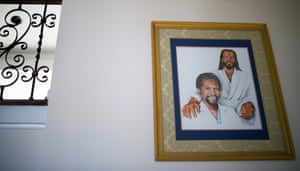
Painting in Carson's Home: Carson at the right hand of Jesus
Dr. Carson's writings and statements about his own formative past have proven similarly elusive. He's said he hit his mother over the head with a hammer and tried to stab a friend who was only saved by his belt buckle. Friends have told CNN they have no memory or knowledge of these incidents. Carson, a doctor, has described his childhood "rage" as a "pathological disease," of which no record of diagnosis or treatment exists. He's claimed to have been invited to dinner as a young man with Gen. William Westmoreland, U.S. commander in Vietnam. Reporters have determined that Carson and Westmoreland were never in the same place at the same time. He also claimed on the Charlie Rose program he was offered a full scholarship to West Point, a school that is free, where there are no scholarships, because there is no tuition if you are admitted. He had prostate cancer surgery in August, 2002 and in November of that year said he had been cured. Two years later, in 2004, he said his prostate cancer had been cured by dietary supplements provided by Mannatech, a company that was paying him $42,000 a speech to represent them and which has been fined $4 million by the state of Texas for making medically spurious claims. When asked about his involvement with this company during the CNN Republican debate on October 28, 2015, he denied having any relationship with Mannatech. Dr. Ben Carson appears to be a serial prevaricator.
When confronted with evidence of his obvious dishonesty Carson has played the victim. Instead of saying 'Ask my classmates, teachers, relatives, or witnesses,' as you or I would do if we were telling the truth, he has fallen back on the Republican politician's dodge of blaming the "liberal media." He maintains "There's no question I'm getting special consideration. The liberal media is out to tear me down. They're after things that happened fifty years ago, that happened when I was 13." No, they are checking into preposterous-sounding things he claims have happened at various times throughout his life, that he has maintained as an adult and as recently as yesterday. Dr. Carson is running for President of the United States and leader of the free world, a position for which he seems to feel he need not have to undergo any scrutiny about the truthfulness of his statements or the content of his character. He is about to be sorely disabused of that notion.
To listen to Dr. Carson for more than a few minutes is to be treated to a set of views that can only be described as bizarre. He has proposed ending Medicare. He wants to phase out Social Security. He has said the Holocaust would not have happened had the Jews been armed. (The Warsaw Jews did arm themselves and rose up against their Nazi tormentors in 1943. Their ghetto was razed in a campaign of savagery that annihilated them all to the last man, woman and child.) He says "Obamacare is the worst thing to happen to America since slavery." He's opined that the ancient pyramids of Egypt were used primarily for grain storage. These strange and loopy views are part and parcel of a fellow who regularly offers opinions completely out of the mainstream politically or completely out of the reality-based factual universe. To be blunt about it, they are the babblings of a crackpot.
Painting in Carson's Home: Carson at the right hand of Jesus
Dr. Carson's writings and statements about his own formative past have proven similarly elusive. He's said he hit his mother over the head with a hammer and tried to stab a friend who was only saved by his belt buckle. Friends have told CNN they have no memory or knowledge of these incidents. Carson, a doctor, has described his childhood "rage" as a "pathological disease," of which no record of diagnosis or treatment exists. He's claimed to have been invited to dinner as a young man with Gen. William Westmoreland, U.S. commander in Vietnam. Reporters have determined that Carson and Westmoreland were never in the same place at the same time. He also claimed on the Charlie Rose program he was offered a full scholarship to West Point, a school that is free, where there are no scholarships, because there is no tuition if you are admitted. He had prostate cancer surgery in August, 2002 and in November of that year said he had been cured. Two years later, in 2004, he said his prostate cancer had been cured by dietary supplements provided by Mannatech, a company that was paying him $42,000 a speech to represent them and which has been fined $4 million by the state of Texas for making medically spurious claims. When asked about his involvement with this company during the CNN Republican debate on October 28, 2015, he denied having any relationship with Mannatech. Dr. Ben Carson appears to be a serial prevaricator.
When confronted with evidence of his obvious dishonesty Carson has played the victim. Instead of saying 'Ask my classmates, teachers, relatives, or witnesses,' as you or I would do if we were telling the truth, he has fallen back on the Republican politician's dodge of blaming the "liberal media." He maintains "There's no question I'm getting special consideration. The liberal media is out to tear me down. They're after things that happened fifty years ago, that happened when I was 13." No, they are checking into preposterous-sounding things he claims have happened at various times throughout his life, that he has maintained as an adult and as recently as yesterday. Dr. Carson is running for President of the United States and leader of the free world, a position for which he seems to feel he need not have to undergo any scrutiny about the truthfulness of his statements or the content of his character. He is about to be sorely disabused of that notion.
Friday, September 18, 2015
Second Republican Debate
The Republican debate on CNN this week was a revelation. Everyone there seemed to have a clear idea of what they're against, but no one appeared to have any kind of coherent picture of what they are for or how they would meet the needs of the American people.
They all hated Obamacare and said would repeal it right away. No one offered an idea of how to improve the health care system or meet the needs of those without insurance.
They all said they would defund Planned Parenthood. None said anything about how they would meet the health needs of women in America without it.
They all said they were against ISIS and would destroy it. No one mentioned that for the US to do that would require an American invasion of Syria, or if that was what they were proposing. (To his credit, at least in terms of honesty, Lindsay Graham actually did admit to having exactly that in mind in the preliminary debate among the four candidates with the weakest support.)
They all said they were against the nuclear inspection deal with Iran. All but two said they would simply tear it up, leaving no inspection protocol in effect at all, and in effect leaving no other option but war. Rand Paul and John Kasich were the only ones to suggest working within the treaty with our allies.
All said they were for harsh crackdowns on "illegal aliens," with Marco Rubio tacitly repudiating his own Senate legislation on comprehensive immigration. No one offered much in the way of solutions other than building more and bigger walls.
Most of all, they all fell all over themselves attacking Hillary Clinton, and each other. There was a cringeworthy back and forth between Jeb Bush and Donald Trump over Bush's allegations that Trump showed up at Bush's Florida office when he was governor with an offer of campaign cash, asking for Bush's help in approving a casino project. Trump's vehement 'no I didn'ts' and Bush's insistent 'yes you dids' reached a new bottom. Apparently lost on everyone was the certainty that at least one of them was lying with pants-on-fire intensity.
All in all, there was little to inspire confidence in the vision of these candidates. Several of them painfully appeared to lack even the basic personal maturity to be considered for such a position of responsibility. Entertainment value can only take you so far.
They all hated Obamacare and said would repeal it right away. No one offered an idea of how to improve the health care system or meet the needs of those without insurance.
They all said they would defund Planned Parenthood. None said anything about how they would meet the health needs of women in America without it.
They all said they were against ISIS and would destroy it. No one mentioned that for the US to do that would require an American invasion of Syria, or if that was what they were proposing. (To his credit, at least in terms of honesty, Lindsay Graham actually did admit to having exactly that in mind in the preliminary debate among the four candidates with the weakest support.)
They all said they were against the nuclear inspection deal with Iran. All but two said they would simply tear it up, leaving no inspection protocol in effect at all, and in effect leaving no other option but war. Rand Paul and John Kasich were the only ones to suggest working within the treaty with our allies.
All said they were for harsh crackdowns on "illegal aliens," with Marco Rubio tacitly repudiating his own Senate legislation on comprehensive immigration. No one offered much in the way of solutions other than building more and bigger walls.
Most of all, they all fell all over themselves attacking Hillary Clinton, and each other. There was a cringeworthy back and forth between Jeb Bush and Donald Trump over Bush's allegations that Trump showed up at Bush's Florida office when he was governor with an offer of campaign cash, asking for Bush's help in approving a casino project. Trump's vehement 'no I didn'ts' and Bush's insistent 'yes you dids' reached a new bottom. Apparently lost on everyone was the certainty that at least one of them was lying with pants-on-fire intensity.
All in all, there was little to inspire confidence in the vision of these candidates. Several of them painfully appeared to lack even the basic personal maturity to be considered for such a position of responsibility. Entertainment value can only take you so far.
Tuesday, August 11, 2015
Trump Phenomenon Tip of Iceberg
What's going on with the Donald Trump phenomenon? I got a note from friend Tim Garner who sent me a link to an opinion piece by Glenn Reynolds in USA Today expounding on the popularity of not only Donald Trump but also Bernie Sanders. You can go to it here. Reynolds's basic point is that the political class is out of touch with everyday Americans and their concerns, and people are looking for solutions outside of the bromides they typically hear from the same old insiders. Reynolds writes, "Trump’s rise is, like that of his Democratic counterpart Bernie Sanders, a sign that a large number of voters don’t feel represented by more mainstream politicians." He is unquestionably right in that assessment.
Where he isn't right is in his contention that the "ruling class" and the political class are the same thing, and in his statement that the big problem is that this ruling class presents an unbroken wall where "On many issues...the Republican and Democratic establishments agree." Anyone who has been paying even minimal attention the past several years is aware of the across-the-board gridlock resulting from irreconcilable Republican and Democratic views on things like health care, taxes, war, immigration, LGBT rights, climate change, the minimum wage, international relations, Medicare and Social Security. Both Hillary Clinton and Bernie Sanders have made reversing income inequality the cornerstones of their respective campaigns, for instance. In neither of the recent top-tier nor the second string Republican debates was one word spoken of it. The ruling class are the billionaires with the money. They work hard to game the system so that the political class are their puppets. The GOP almost completely is. The Democrats are not yet fully so.
Where he isn't right is in his contention that the "ruling class" and the political class are the same thing, and in his statement that the big problem is that this ruling class presents an unbroken wall where "On many issues...the Republican and Democratic establishments agree." Anyone who has been paying even minimal attention the past several years is aware of the across-the-board gridlock resulting from irreconcilable Republican and Democratic views on things like health care, taxes, war, immigration, LGBT rights, climate change, the minimum wage, international relations, Medicare and Social Security. Both Hillary Clinton and Bernie Sanders have made reversing income inequality the cornerstones of their respective campaigns, for instance. In neither of the recent top-tier nor the second string Republican debates was one word spoken of it. The ruling class are the billionaires with the money. They work hard to game the system so that the political class are their puppets. The GOP almost completely is. The Democrats are not yet fully so.
There
is no question these candidates are indeed, as the author states,
tapping into an angst among the rank and file that feels increasingly
alienated from the political and/or ruling class. The root of the angst
is that the standard of living and opportunity ladder for average
Americans has stagnated for over three decades now. The problem of
focusing this discontent is that the disaffected are not of one mind.
The Tea Party types who like Trump (Cruz, Paul, Carson, et. al.) think
government is the problem and want to devolve it. The Leftish types who
like Sanders think corporatism and plutocracy are the problem and want
strong government under the people's control to rein in this
ruling class and force it to share the profits with the workers and
provide more opportunity (free college, medical care and so on) to the
average folks. It will be fascinating (maybe frightening) to see how
this eventually explodes.
Getting
the billionaire and corporate money out of the political campaign
process is, in my view, the prerequisite for heading off the explosion
and restoring better responsiveness. I am, as you likely know, in
sympathy with what I referred to as the Leftish analysis.
Monday, July 20, 2015
GOP Racism Revealed in Fox Poll
The most recent Fox News poll shows Donald Trump the current front runner among the Republican candidate field and an alarmingly high level of racism among the Republican electorate. Trump, who has gained notoriety among the general public for his characterizations of Mexican immigrants as "rapists and murderers" is the choice of 18% of Republican voters in the survey. Wisconsin Governor Scott Walker comes in second with 15% and former Florida Governor Jeb Bush stands in third place with 14%. None of the other galaxy of GOP candidates registers in double figures. The poll was jointly conducted by Anderson Robbins, which usually surveys for Democrats, and Shaw & Company, which usually surveys for Republicans.
To show where the minds of voters are, 59% of all those polled felt Trump is "just a loud mouth," but among Republican primary voters, 59% said they admire the Donald. The main reason? Because "he's got guts." While 64% of all those polled support a path to citizenship for undocumented immigrants, 68% of Republican primary voters say that Trump is "basically right" in his views about Mexican immigrants. The picture of GOP voters that emerges is that of a bloc sorely out of touch with the general public and infected with admiration for those who spew racist invective, so long as it is done emphatically.
The first Republican debate is in three weeks and will feature the ten candidates who score highest in an average of popularity polls. Recent results practically guarantee Trump will be on the stage.
To show where the minds of voters are, 59% of all those polled felt Trump is "just a loud mouth," but among Republican primary voters, 59% said they admire the Donald. The main reason? Because "he's got guts." While 64% of all those polled support a path to citizenship for undocumented immigrants, 68% of Republican primary voters say that Trump is "basically right" in his views about Mexican immigrants. The picture of GOP voters that emerges is that of a bloc sorely out of touch with the general public and infected with admiration for those who spew racist invective, so long as it is done emphatically.
The first Republican debate is in three weeks and will feature the ten candidates who score highest in an average of popularity polls. Recent results practically guarantee Trump will be on the stage.
Tuesday, February 10, 2015
Top Republican 2016 Contenders
It looks as though there may be a very large field of Republican presidential aspirants for the 2016 nomination. Quite a few will be able to make headlines and five or six could win primaries or caucuses in particular states. Much could happen to change existing dynamics, such as devastating gaffes or disqualifying revelations. But at this early stage I feel there are only two to really watch: Jeb Bush and Scott Walker.
Bush has name recognition, family political organization and a nearly inexhaustible fundraising network going for him. The former Florida governor (1999-2007) can point to executive experience outside of Washington, which in the world of Republican politics could help make this dynastic insider an appealing "outsider" in the minds of GOP primary voters. The money angle is a very powerful determinant in Republican primary politics. Mitt Romney had that advantage in 2012 and used it to bury Newt Gingrich and Rick Santorum in negative ads on his way to the nomination that year. This time, it was the realization that the big money was going for Bush that led to Romney's abrupt abandonment of his developing third White House run.
Wisconsin Governor Scott Walker is the challenger most likely to wrest the nomination away from Bush, if anyone can. Walker has three things going for him that make him very attractive to the base GOP primary voter. First, he's won three elections in a normally Democratic state. He was elected governor in 2010, survived a recall attempt in 2012 and was re-elected in 2014. Second, the recall took place over his success in gutting union rights in his state, another feather in his cap to conservatives. And third, he subscribes to the full range of conservative social issues positions on things like abortion, contraception, marriage equality and voting restrictions. While he may not have pockets quite as deep as Bush, Walker is a major favorite of the Koch machine, and their resources are plenty.
All kinds of potential candidates will certainly make things interesting on the Republican side. Mike Huckabee, Rand Paul, Marco Rubio, Chris Christie, Ted Cruz and even Ben Carson have their followings. But in my early handicapping, Bush and Walker are the ones to watch. Bush is the preeminent establishment candidate, with positioning suited to the national electorate and great resources to back up his run. Walker has the resources to compete and though less well-positioned for the general election voter, is dearer to the heart of the typical Republican primary electorate. Watch the polls to see how this starts shaking out. Bush is ahead in the early national surveys, while Walker has gained an early lead in New Hampshire.
Bush has name recognition, family political organization and a nearly inexhaustible fundraising network going for him. The former Florida governor (1999-2007) can point to executive experience outside of Washington, which in the world of Republican politics could help make this dynastic insider an appealing "outsider" in the minds of GOP primary voters. The money angle is a very powerful determinant in Republican primary politics. Mitt Romney had that advantage in 2012 and used it to bury Newt Gingrich and Rick Santorum in negative ads on his way to the nomination that year. This time, it was the realization that the big money was going for Bush that led to Romney's abrupt abandonment of his developing third White House run.
Wisconsin Governor Scott Walker is the challenger most likely to wrest the nomination away from Bush, if anyone can. Walker has three things going for him that make him very attractive to the base GOP primary voter. First, he's won three elections in a normally Democratic state. He was elected governor in 2010, survived a recall attempt in 2012 and was re-elected in 2014. Second, the recall took place over his success in gutting union rights in his state, another feather in his cap to conservatives. And third, he subscribes to the full range of conservative social issues positions on things like abortion, contraception, marriage equality and voting restrictions. While he may not have pockets quite as deep as Bush, Walker is a major favorite of the Koch machine, and their resources are plenty.
All kinds of potential candidates will certainly make things interesting on the Republican side. Mike Huckabee, Rand Paul, Marco Rubio, Chris Christie, Ted Cruz and even Ben Carson have their followings. But in my early handicapping, Bush and Walker are the ones to watch. Bush is the preeminent establishment candidate, with positioning suited to the national electorate and great resources to back up his run. Walker has the resources to compete and though less well-positioned for the general election voter, is dearer to the heart of the typical Republican primary electorate. Watch the polls to see how this starts shaking out. Bush is ahead in the early national surveys, while Walker has gained an early lead in New Hampshire.
Subscribe to:
Posts (Atom)