Showing posts with label Environment. Show all posts
Showing posts with label Environment. Show all posts
Thursday, January 21, 2016
2015 Was Hottest Year On Record
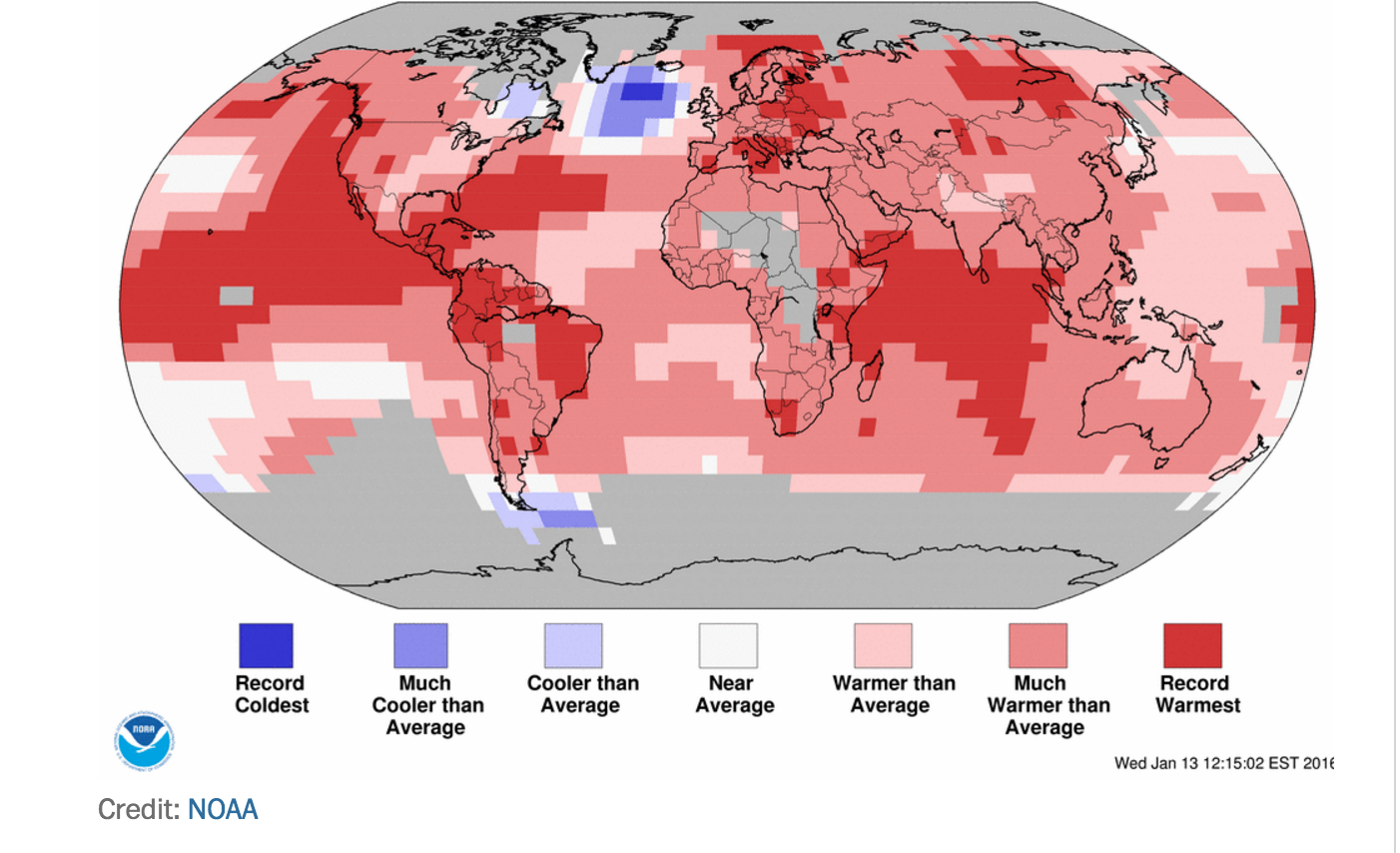
Climate change is back in the news again. The final figures show 2015 was the hottest year on record. By a lot. NASA and the National Oceanic and Atmospheric Administration have both announced it as official. It topped the previous record (2014) by .23 of a degree, almost 1/4 of a degree, when most of the other records have been by a hundredth or two. Here are the global facts in graphic form. It's interesting to note that 1988 set a "hottest" record at the time, and it's not even in the top 20 any more. The recent Paris climate accord shows the world's leaders get it. It's time for the deniers to give it up, and for reasonable people to ignore them. This debate is over.

Thursday, June 18, 2015
Pope Speaks Out on Climate Change
Today Pope Francis released his encyclical on human-generated climate change and the need for the people and governments of the world to band together to reverse the damage being done to creation and to our ecological home. As he put it, "Once
we start to think about the kind of world we are leaving to future
generations, we look at things differently; we realize that the world is
a gift which we have freely received and must share with others," he
said. The Archdiocese of Los Angeles is teaming up with the Sierra Club to ask people to sign a petition calling on world leaders to act to fight this threat.
Conservative figures such as Sean Hannity and Rush Limbaugh and candidates Jeb Bush and Rick Santorum have already weighed in against the pontiff for "politicizing" the climate issue. What they don't seem to realize is that the scientist pope (master's degree in Chemistry) is merely reporting the science and combining that with his moral focus as a religious leader to call for mitigation of the effects of this preventable tragedy on the "least among us." As Francis pointed out, it is the poor and powerless who pay the highest price for drought and sea level rise. See the entire text of the encyclical (184 pages) here. See the informative article on the encyclical, Laudate Si, (Praise be to you) in the New York Times here.
It is well past time for the narrative to change. Scientists who report the findings of science and moral leaders who report the human dimension of issues are not the ones "politicizing" this issue. People who know better but play to the fear and ignorance of their political base by denying fact and reason are the ones doing so. It is well past time for them to be called on this dissimulation, and it is good to see the Pope doing so.
Tuesday, February 24, 2015
Climate Change Denier "Scientist" on Industry Payroll
Years ago the tobacco industry funded "researchers" who generated "studies" to show the evidence was still inconclusive on the harmful effects of smoking. This fed their narrative that nothing ought to be done until more "conclusive" results were available. It has long been suspected that the fossil fuel industry has been operating the same way regarding greenhouse gas accumulations and the rising temperature of the atmosphere. Now there's proof.
It turns out a prominent global warming "skeptic," often quoted by conservative politicians and pundits, has been paid $1.2 million by oil industry sources, including the Koch brothers. Wie-Hock (Willie) Soon, an aerospace engineer and part-time employee at the Harvard-Smithsonian Center for Astrophysics, has published 11 papers since 2008 claiming that the sun is heating up and that is the main cause of earth's warming climate. The Nobel Prize-winning U.N. International Panel on Climate Change has studied the data and finds changes in the sun account for less than one percent of the effect of greenhouse gases.
Soon's papers were published without mention of this funding, in violation of academic ethics guidelines. The facts came out thanks to a Freedom of Information request by the environmental group Greenpeace. In communications with his corporate paymasters Soon even referred to his writings for them as "deliverables."
It turns out a prominent global warming "skeptic," often quoted by conservative politicians and pundits, has been paid $1.2 million by oil industry sources, including the Koch brothers. Wie-Hock (Willie) Soon, an aerospace engineer and part-time employee at the Harvard-Smithsonian Center for Astrophysics, has published 11 papers since 2008 claiming that the sun is heating up and that is the main cause of earth's warming climate. The Nobel Prize-winning U.N. International Panel on Climate Change has studied the data and finds changes in the sun account for less than one percent of the effect of greenhouse gases.
Soon's papers were published without mention of this funding, in violation of academic ethics guidelines. The facts came out thanks to a Freedom of Information request by the environmental group Greenpeace. In communications with his corporate paymasters Soon even referred to his writings for them as "deliverables."
Monday, March 24, 2014
Tweny-Five Year Anniversary of Exxon Valdez Disaster
Twenty-five years ago today, on March 24, 2014, the supertanker Exxon Valdez ran aground in Prince William Sound off the coast of Alaska. The 11-million-gallon oil spill killed an estimated 200,000 sea birds and wrecked the regional fishing industry. Though some species have recovered to pre-spill levels, the herring and orcas have never rebounded past a tiny fraction of their former numbers. Click here for a recap and update on the disaster.
Though all agree safety has improved considerably in the years since, with double-hulled ships, blood testing (the captain of the Exxon Valdez had been drinking) and somewhat stiffer penalties for toxic spills, recent events prove that as long as we rely on these highly poisonous fuels for the bulk of our energy, accidents are inevitable. Equipment fails and humans make mistakes. The 2010 BP Deep Horizon Rig disaster killed eleven workers and put an estimated 200 million gallons into the Gulf of Mexico. Just yesterday, a barge collision with a ship in the Houston Ship Channel near Galveston has leaked some 170,000 gallons there so far.
The race to extract hydrocarbons from ever more difficult environments guarantees there will be serious environmental costs. Such processes as drilling under ever deeper waters, particularly including the Arctic seabed, unearthing coal by mountain top removal and squeezing hard-to-reach oil and natural gas from rock formations by fracking are fraught with sufficient risks that the laws of probability ensure regular episodes of devastation.
The sad truth is that our means of coping have advanced but little. The toxic dispersants and floating booms and sweeps they use today are little changed in the quarter century since Exxon Valdez entered our consciousness. Our development of solar and wind resources are accelerating but remain at a relative snail's pace compared to the surging world demand for coal, oil and gas. We must do better than this.
Though all agree safety has improved considerably in the years since, with double-hulled ships, blood testing (the captain of the Exxon Valdez had been drinking) and somewhat stiffer penalties for toxic spills, recent events prove that as long as we rely on these highly poisonous fuels for the bulk of our energy, accidents are inevitable. Equipment fails and humans make mistakes. The 2010 BP Deep Horizon Rig disaster killed eleven workers and put an estimated 200 million gallons into the Gulf of Mexico. Just yesterday, a barge collision with a ship in the Houston Ship Channel near Galveston has leaked some 170,000 gallons there so far.
The race to extract hydrocarbons from ever more difficult environments guarantees there will be serious environmental costs. Such processes as drilling under ever deeper waters, particularly including the Arctic seabed, unearthing coal by mountain top removal and squeezing hard-to-reach oil and natural gas from rock formations by fracking are fraught with sufficient risks that the laws of probability ensure regular episodes of devastation.
The sad truth is that our means of coping have advanced but little. The toxic dispersants and floating booms and sweeps they use today are little changed in the quarter century since Exxon Valdez entered our consciousness. Our development of solar and wind resources are accelerating but remain at a relative snail's pace compared to the surging world demand for coal, oil and gas. We must do better than this.
Sunday, February 9, 2014
Getting Real About Water
I recently went to a most enlightening presentation by Bill Tweed, retired Chief Naturalist at Sequoia National Park, on the long-term water situation in California, especially Central California. I must say it's drastically changed my views. The bottom line is that we will not be able to keep intensively farming the entire Central Valley. Year after year, the process uses more water than nature provides. It's fundamentally unsustainable. Here is an outline of his masterful presentation based on my notes.
Bill began with 10 facts about California water:
1. Water here is variable. Precipitation varies on average from 4 inches a year in Coalinga on the west side to 9 inches in Visalia on the east, to 50 inches at Lodgepole in Sequoia at 7,000 feet. Much more falls in Northern California than Central and Southern.
2. Yearly rainfall is unreliable. From year to year it varies by a factor of 5 times.
3. The economic basis of the Central Valley region, agriculture, depends on reliable water-which is not the norm.
4. Only one-third of our needs are met by the natural flow.
5. There is insufficient water to maintain current usage.
6. The deficit is made up by importing water.
7. There is an annual overdraft of ground and imported water (as through the California Aqueduct) of 3 million acre feet a year-equal to the combined entire annual flows of the Kings and San Joaquin Rivers. The former 20-foot-deep water table is now more than 300 feet. The deeper you have to pump, the more you pay in energy. At some point, the ground water will be gone.
8. Not all current farmland is "prime." There is much marginal hard pan, alkaline and saline irrigation runoff land, for instance.
9. It's going to get harder, not easier. The warming climate will result in a reduced winter snow pack. All climate models agree that the warming climate will produce even more annual unpredictability.
10. It's going to get warmer. It's already 2 degrees warmer than the 1960's, more at higher elevations. That means more evaporation from lakes, rivers and vegetation.
Additional Considerations:
Sacramento Delta: It's a "broken system, about to fail." It's already below sea level and polar ice melt means the sea level is rising. The earthen levees that protect it are deteriorating. If we pump more water out of it or reduce the flow into it sea water intrusion will happen even faster. Saving Central Valley farmland would thus entail sacrificing Delta farmland.
Water Storage: We have already built and dammed the best sites. New storage will come at a higher marginal cost. Silting at existing sites is beginning to appreciably reduce current storage capacity.
Growing Population: California added over 3.4 million people from the 2000 census to the 2010 census. Usually, city water needs in the end win out over rural ones. Cities are where the votes are.
Desalination: It costs $1.01 per thousand gallons compared to 10 to 20 cents per thousand gallons for surface or ground water.
Fracking of the Monterey Shale: It takes a lot of water, already our scarcest resource. Do we use our water to get oil? If so, what water uses are we willing to do without?
Concluding Choices:
We need to rethink what we want for the Valley long-term.
We cannot continue to farm the whole San Joaquin Valley.
On the West Side we have created an artificial industry which is not sustainable.
We have many competing interests: Individual versus society, short term versus long term.
We cannot do everything. The resources are not there.
All current suggestions for ending the problem amount to "robbing Peter to pay Paul."
The Basic Question:
"How, in a democratic society, do we limit ourselves?" Political leaders, to stay popular, must promise all things to all people. Because we demand them to, they promise plenty of inexpensive water for all interests, urban and rural. In the long term this is not deliverable.
If I may summarize, the situation calls for realism. Do we go on the way we are until the wells run dry, devastating the region all at once? Do we quintuple the price of water, making all farming uncompetitive here? Or do we limit use according to a fair, sustainable and rationally planned program? It will be one of the three, whether intentionally or not. As the old saying goes, "Not to decide is to decide."
Bill began with 10 facts about California water:
1. Water here is variable. Precipitation varies on average from 4 inches a year in Coalinga on the west side to 9 inches in Visalia on the east, to 50 inches at Lodgepole in Sequoia at 7,000 feet. Much more falls in Northern California than Central and Southern.
2. Yearly rainfall is unreliable. From year to year it varies by a factor of 5 times.
3. The economic basis of the Central Valley region, agriculture, depends on reliable water-which is not the norm.
4. Only one-third of our needs are met by the natural flow.
5. There is insufficient water to maintain current usage.
6. The deficit is made up by importing water.
7. There is an annual overdraft of ground and imported water (as through the California Aqueduct) of 3 million acre feet a year-equal to the combined entire annual flows of the Kings and San Joaquin Rivers. The former 20-foot-deep water table is now more than 300 feet. The deeper you have to pump, the more you pay in energy. At some point, the ground water will be gone.
8. Not all current farmland is "prime." There is much marginal hard pan, alkaline and saline irrigation runoff land, for instance.
9. It's going to get harder, not easier. The warming climate will result in a reduced winter snow pack. All climate models agree that the warming climate will produce even more annual unpredictability.
10. It's going to get warmer. It's already 2 degrees warmer than the 1960's, more at higher elevations. That means more evaporation from lakes, rivers and vegetation.
Additional Considerations:
Sacramento Delta: It's a "broken system, about to fail." It's already below sea level and polar ice melt means the sea level is rising. The earthen levees that protect it are deteriorating. If we pump more water out of it or reduce the flow into it sea water intrusion will happen even faster. Saving Central Valley farmland would thus entail sacrificing Delta farmland.
Water Storage: We have already built and dammed the best sites. New storage will come at a higher marginal cost. Silting at existing sites is beginning to appreciably reduce current storage capacity.
Growing Population: California added over 3.4 million people from the 2000 census to the 2010 census. Usually, city water needs in the end win out over rural ones. Cities are where the votes are.
Desalination: It costs $1.01 per thousand gallons compared to 10 to 20 cents per thousand gallons for surface or ground water.
Fracking of the Monterey Shale: It takes a lot of water, already our scarcest resource. Do we use our water to get oil? If so, what water uses are we willing to do without?
Concluding Choices:
We need to rethink what we want for the Valley long-term.
We cannot continue to farm the whole San Joaquin Valley.
On the West Side we have created an artificial industry which is not sustainable.
We have many competing interests: Individual versus society, short term versus long term.
We cannot do everything. The resources are not there.
All current suggestions for ending the problem amount to "robbing Peter to pay Paul."
The Basic Question:
"How, in a democratic society, do we limit ourselves?" Political leaders, to stay popular, must promise all things to all people. Because we demand them to, they promise plenty of inexpensive water for all interests, urban and rural. In the long term this is not deliverable.
If I may summarize, the situation calls for realism. Do we go on the way we are until the wells run dry, devastating the region all at once? Do we quintuple the price of water, making all farming uncompetitive here? Or do we limit use according to a fair, sustainable and rationally planned program? It will be one of the three, whether intentionally or not. As the old saying goes, "Not to decide is to decide."
Friday, January 17, 2014
Air Quality Still a Major Concern
Mark Grossi writes a San Joaquin Valley environmental blog that is frequently published in the Fresno Bee under the title "Earth Log." Two of his recent items on air quality certainly got my attention as a valley resident. One concerned soot and the other ozone.
The soot item was a study done on rhesus macaque monkeys in 2008. That year saw a huge number of wildfires, over 2,000. The air consequently had high concentrations of PM-2.5. That's the designation standing for "particulate matter" or small particles under 2.5 microns in size. It is often composed of smoke, diesel exhaust and grains of dust. These tiny particles can lodge in the lungs. Researchers at the University of California at Davis tracked the progress of monkey babies born that year and compared their health records to those of monkeys born the next year when the air quality was better. They found that monkeys born that year were more susceptible to bacterial infections and have reduced lung capacity overall. Significantly, monkey lungs are practically the same as those of humans. And in what Grossi termed a "chilling" development, thanks to this year's extreme drought leading to a high dust count in the air, current PM-2.5 readings are even higher than those recorded in the 2008 wildfire year. This doesn't portend good news for children's health. The one partial silver lining is that the monkeys studied lived outside and were thus exposed longer per day to the particulates than most human babies are. But it does point up an inescapable reality: society pays and people pay a serious price for environmental pollution.
The other item was about ozone, one of the main components of photochemical "smog." In the early 1990s the San Joaquin Valley regularly had 130 days a year when the federal 8-hour ozone standard was exceeded. The geography of the area, a bowl enclosed by the Coast Ranges to the west and the Sierra Nevada to the east, makes it difficult in the absence of strong wind or precipitation to clear out the air and prevent pollutants from accumulating. The good news is that the region has made real progress. Thanks to such actions as smog controls and better gas mileage for vehicles, phasing out older, dirty power plants, farm machinery and well motors, and banning fireplace usage on bad air days, 2013 set a new record. There were "only" 91 ozone violation days. But the bad news is that 91 was still second worst in the nation. Only the South Coast Air Basin comprising Los Angeles and its environs with 93 violations in 2013 did worse. It is a real achievement to have reduced the number of bad smog days by 30%. But at the same time, it is only realistic to acknowledge that the situation is still bad and there remains a long way to go.
The soot item was a study done on rhesus macaque monkeys in 2008. That year saw a huge number of wildfires, over 2,000. The air consequently had high concentrations of PM-2.5. That's the designation standing for "particulate matter" or small particles under 2.5 microns in size. It is often composed of smoke, diesel exhaust and grains of dust. These tiny particles can lodge in the lungs. Researchers at the University of California at Davis tracked the progress of monkey babies born that year and compared their health records to those of monkeys born the next year when the air quality was better. They found that monkeys born that year were more susceptible to bacterial infections and have reduced lung capacity overall. Significantly, monkey lungs are practically the same as those of humans. And in what Grossi termed a "chilling" development, thanks to this year's extreme drought leading to a high dust count in the air, current PM-2.5 readings are even higher than those recorded in the 2008 wildfire year. This doesn't portend good news for children's health. The one partial silver lining is that the monkeys studied lived outside and were thus exposed longer per day to the particulates than most human babies are. But it does point up an inescapable reality: society pays and people pay a serious price for environmental pollution.
The other item was about ozone, one of the main components of photochemical "smog." In the early 1990s the San Joaquin Valley regularly had 130 days a year when the federal 8-hour ozone standard was exceeded. The geography of the area, a bowl enclosed by the Coast Ranges to the west and the Sierra Nevada to the east, makes it difficult in the absence of strong wind or precipitation to clear out the air and prevent pollutants from accumulating. The good news is that the region has made real progress. Thanks to such actions as smog controls and better gas mileage for vehicles, phasing out older, dirty power plants, farm machinery and well motors, and banning fireplace usage on bad air days, 2013 set a new record. There were "only" 91 ozone violation days. But the bad news is that 91 was still second worst in the nation. Only the South Coast Air Basin comprising Los Angeles and its environs with 93 violations in 2013 did worse. It is a real achievement to have reduced the number of bad smog days by 30%. But at the same time, it is only realistic to acknowledge that the situation is still bad and there remains a long way to go.
Sunday, November 10, 2013
Fracking Questions
Hydraulic fracturing is a technique to get more oil or natural gas from rock
formations deep underground. It involves
injecting water and a stew of dissolved volatile chemicals into a well under
high pressure. The process fractures
rock, freeing hard-to-get-at oil and gas deposits and increasing the production
of wells. It’s being used in new fields
such as North Dakota and Wyoming with geological strata that have been hard to
drill up to now, and in old fields such as Pennsylvania to squeeze more
hydrocarbons out of formations that had previously been tapped but left a lot
of fossil fuel underground that couldn’t be recovered using older
technologies. California is another state
that has large reserves from older fields that will likely become prime
industry targets due to fracking. These
are primarily in the massive Monterey Shale formation which rests beneath much
of the central portion of the state, including the San Joaquin Valley.
People like me who are concerned about the environment are highly suspicious of fracking for a
number of reasons. First, we want to put
more emphasis on clean, renewable energy sources such as wind, solar, geothermal
and tidal. Fossil fuels are what’s
putting poison into our breathing air and raising global temperatures through
the greenhouse effect of gasses like carbon dioxide and methane. On the whole, we and the earth would be a lot
better off phasing out fossil fuels in favor of their clean alternatives rather
than finding new ways to produce more of them.
Second, we are alarmed about the possibility of toxic chemicals such as
solvents being injected into the ground and contaminating the water table we
use for irrigation and drinking water.
Third, fracking has been associated with earthquake activity in
Pennsylvania. To what extent will
breaking up subterranean rock formations act to destabilize the crust and set
off subsidence and quakes? Is that
something we really want to mess with?
There needs to see a lot more research and provisions for serious safeguards
before we should be the least bit enthusiastic about opening up this Pandora’s box.
Sunday, November 3, 2013
Congressional Climate Denial
Global temperatures have been warmer than average for 341 consecutive months. 97% of climate scientists agree the earth's temperature is warming and that human activities are the primary cause. Even so, an article in Think Progress finds that 57% of Republicans in congress have made a public statement either denying that climate change is happening or that humans have anything to do with it.
What's more, the denial pays. Think Progress figures show that climate deniers in the House receive an average of $241,000 in contributions from dirty energy companies while non-deniers get $69,000 from them. That's better than a three-and-a-half-to-one spread. The disparity is even more pronounced, over four-to-one in the Senate, where climate deniers average $699,000 from dirty energy contributions and non-deniers get $171,000.
The Sierra Club Magazine produced a graphic to display the political landscape reported on in Think Progress. I've included it below.

As you can see, the House of Representatives has 200 Democrats, and every last one of them accepts the findings of climate science. Of the 233 Republicans in the House, 128 (55%) are known climate deniers. The Senate is even worse. The 52 Democrats and 2 Independents who caucus with them (Bernie Sanders of Vermont and Angus King of Maine) are all climate realists. But 30 of the 46 Senate Republicans (65%) are deniers. And when it comes to the GOP congressional leadership, the opacity is nearly absolute. Think Progress reports 90% of them are on the denial bandwagon.
What's more, the denial pays. Think Progress figures show that climate deniers in the House receive an average of $241,000 in contributions from dirty energy companies while non-deniers get $69,000 from them. That's better than a three-and-a-half-to-one spread. The disparity is even more pronounced, over four-to-one in the Senate, where climate deniers average $699,000 from dirty energy contributions and non-deniers get $171,000.
The Sierra Club Magazine produced a graphic to display the political landscape reported on in Think Progress. I've included it below.
As you can see, the House of Representatives has 200 Democrats, and every last one of them accepts the findings of climate science. Of the 233 Republicans in the House, 128 (55%) are known climate deniers. The Senate is even worse. The 52 Democrats and 2 Independents who caucus with them (Bernie Sanders of Vermont and Angus King of Maine) are all climate realists. But 30 of the 46 Senate Republicans (65%) are deniers. And when it comes to the GOP congressional leadership, the opacity is nearly absolute. Think Progress reports 90% of them are on the denial bandwagon.
Saturday, July 13, 2013
Air Pollution Kills
The New York Times reports that the National Academy of Sciences has released a scientific finding on air pollution. It finds that people in the northern part of China have their lifespans shortened by an average of five years compared to residents of southern China. The reason? Heavy air pollution caused by the massive proliferation of coal-fired electrical power plants. The north is industrializing to a greater extent than the south, accounting for most of the difference. There are also greater hydroelectric resources in the south.
The study was conducted by four scientists: two Chinese, one American, and one Israeli. The study, examining records over a 20-year period from 1981-2001, may actually understate the effect, since many more plants have been built since then. Such statistical analyses over twenty years and encompassing a large population make clear the heavy human cost of specific developmental choices.
The message is clear: cost-benefit calculations must include more than just direct economic factors. They need to extend to such factors as medical, life-expectancy, water and indeed all human and environmental costs associated with any contemplated course of action. That would show the true cost of some seemingly cheaper developmental options.
The study was conducted by four scientists: two Chinese, one American, and one Israeli. The study, examining records over a 20-year period from 1981-2001, may actually understate the effect, since many more plants have been built since then. Such statistical analyses over twenty years and encompassing a large population make clear the heavy human cost of specific developmental choices.
The message is clear: cost-benefit calculations must include more than just direct economic factors. They need to extend to such factors as medical, life-expectancy, water and indeed all human and environmental costs associated with any contemplated course of action. That would show the true cost of some seemingly cheaper developmental options.
Sunday, March 10, 2013
Heat Spike Unprecedented in Last 11,000 Years
Yet more evidence has come in about the extreme and growing effects of human-generated climate change. Associated Press Science writer Seth Borenstein reports that data published in the journal Science documents a recent study showing global temperature had been slowly cooling until it dramatically reversed in the last 100 years. See his summary article here. If you're really geeky you can see the abstract in Science with a link to the entire published study here.
Researchers studied the fossils of small temperature-sensitive marine organisms to extend temperature records back 11,300 years. What they found was a gradual warming until 6,000 years ago, and gradual cooling until about 1910. The decade ending in 1910 was one of the coolest recorded. That abruptly reversed and continues to accelerate at a pace much faster than the temperature changes that ended the Ice Age. Lead researcher Shaun Marcott of Oregon State University said, "We've never seen something this rapid. Even in the Ice Age the global temperature never changed this quickly."
It appears that we may have been slowly heading back into an ice age period based on very long term changes in the earth's orbit that take it farther away from the sun and tilt the axis more steeply so that solar radiation falls less directly on the planet's surface. But these natural cooling factors have been massively overridden by an atmosphere that now contains 395 parts per million of carbon dioxide, up from about 280 ppm before the Industrial Revolution began a little over 200 years ago.
Researchers studied the fossils of small temperature-sensitive marine organisms to extend temperature records back 11,300 years. What they found was a gradual warming until 6,000 years ago, and gradual cooling until about 1910. The decade ending in 1910 was one of the coolest recorded. That abruptly reversed and continues to accelerate at a pace much faster than the temperature changes that ended the Ice Age. Lead researcher Shaun Marcott of Oregon State University said, "We've never seen something this rapid. Even in the Ice Age the global temperature never changed this quickly."
It appears that we may have been slowly heading back into an ice age period based on very long term changes in the earth's orbit that take it farther away from the sun and tilt the axis more steeply so that solar radiation falls less directly on the planet's surface. But these natural cooling factors have been massively overridden by an atmosphere that now contains 395 parts per million of carbon dioxide, up from about 280 ppm before the Industrial Revolution began a little over 200 years ago.
Wednesday, January 9, 2013
2012 Hottest Year on Record in U.S.
Last night we got yet more confirmation of the rapidly growing effects of human-accelerated climate heating. The lead story on ABC News, the New York Times, Washington Post and a host of other media outlets was the finding that 2012 was the hottest year on record in the United States, and also one of the hottest on record world wide. Look at this National Oceanographic and Atmospheric Administration map of how each state's 2012 average temperature ranked of the 118 years since records have been kept. See their entire bulletin here.
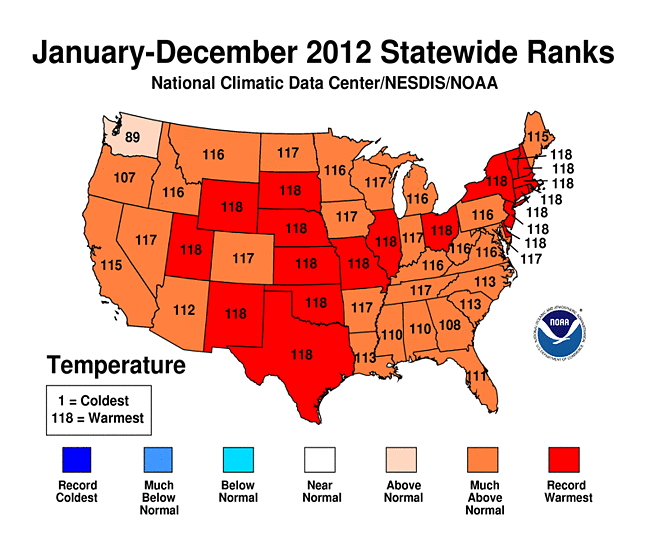
Not only was every state's temperature above normal, but the U.S. average for the entire year was 1.0 full degree above the previous record of 54.3 degrees set in 1998. This is strikingly unusual, since the difference between the hottest and coldest years up to now had only been 4.2 degrees. When the figures are in, the weather service expects 2012 to have been the ninth warmest worldwide. The ten warmest have all come within the past fifteen years, and in fact no year has been cooler than normal since 1985.
The scientists warned that last year's drought, affecting 61% of the nation, and extreme storms (an unprecedented 11 for the year) are but a "foretaste of things to come." Meanwhile, to no one's surprise, Fox News did not mention the story. In the chart below, see the powerful correlation between carbon dioxide in the atmosphere in the top line and temperature in the bottom line over the past 400,000 years.

To make matters worse, according to to NASA, human activity is putting an additional 8 billion metric tons of carbon into the air every year. We will continue to pay an increasingly steep, and even deadly, cost for this over the next few decades.
Monday, June 25, 2012
Seeing Glacier Before It's Too Late
At the end of the week we'll be leaving on a trip I've been looking forward to for many years. My mother often spoke glowingly of a trip she took as a young woman, before I was born and even before she met my father. Back in the late 1940s she and a couple of friends toured throughout the West to many of the National Parks and Monuments. That was quite an undertaking for three women at that time, long before the interstate freeway system. One of the places she spoke of most fondly was Glacier National Park.
For some time I've wanted to see the park in the northern Rockies known as the "Crown of the Continent," and this will finally be the year. I've been particularly eager of late because the namesake glaciers are melting fast. They will probably be gone by 2030, say the climate scientists. It's all part of an ongoing human-caused catastrophe that's underway and gaining momentum.
In this quarter's National Parks magazine, a publication of the National Parks Conservation Association, the grim facts are presented. The toll will likely claim, by 2100, roughly 40 percent of global plant and animal species, "including 21 percent of mammals, 37 percent of freshwater fish and 70 percent of plants." Global sea level is up 2 inches, but over 4 inches on the U.S. East Coast. As the Greenland and West Antarctic ice sheets continue to melt, the ocean should rise by over four feet by century's end. That would inundate the Everglades, a third of Olympic National Park's coastline and a number of island nations.
So we'll enjoy Lake McDonald and traverse Going to the Sun Road. We'll ride pack horses and hike around Many Glacier. We'll skip across the border one day and cruise Waterton Lake on the Canadian side. We'll see moose, elk and maybe grizzlies. At least the pictures will last!
For some time I've wanted to see the park in the northern Rockies known as the "Crown of the Continent," and this will finally be the year. I've been particularly eager of late because the namesake glaciers are melting fast. They will probably be gone by 2030, say the climate scientists. It's all part of an ongoing human-caused catastrophe that's underway and gaining momentum.
In this quarter's National Parks magazine, a publication of the National Parks Conservation Association, the grim facts are presented. The toll will likely claim, by 2100, roughly 40 percent of global plant and animal species, "including 21 percent of mammals, 37 percent of freshwater fish and 70 percent of plants." Global sea level is up 2 inches, but over 4 inches on the U.S. East Coast. As the Greenland and West Antarctic ice sheets continue to melt, the ocean should rise by over four feet by century's end. That would inundate the Everglades, a third of Olympic National Park's coastline and a number of island nations.
So we'll enjoy Lake McDonald and traverse Going to the Sun Road. We'll ride pack horses and hike around Many Glacier. We'll skip across the border one day and cruise Waterton Lake on the Canadian side. We'll see moose, elk and maybe grizzlies. At least the pictures will last!
Sunday, June 17, 2012
Is Coal on the Way Out?
There is good news on the energy and environmental fronts: the use of coal is declining, and fast. Jonathan Fahey of the Associated Press reports in a new article that the proportion of U.S. electrical generation powered by coal has dropped from 50% to less than 40% in just the past four years. The reason? Natural gas is now beating coal, not only to meet tighter EPA clean air regulations, but also on price as supplies unleashed by new technologies become more abundant.
To show you how fast this is happening, natural gas "will be used to produce 29% of the country's electricity this year, up from 20% in 2008." Another 20% comes from nuclear power plants, and 11% comes from renewable sources such as hydroelectric, wind and solar. To underscore how much this trend is worrying the coal industry, I saw a TV commercial from them this morning. Click on this link to see how they are pushing back.
The transition is environmentally significant because, as the AP article reports, "Power plants that burn coal produce more than 90 times as much sulfur dioxide, five times as much nitrogen oxide and twice as much carbon dioxide as those that run on natural gas, according to the Government Accountability Office, the regulatory arm of Congress. Sulfur dioxide causes acid rain; nitrogen oxides cause smog; and carbon dioxide is a so-called greenhouse gas that traps heat in the atmosphere." This March, EPA issued new regulations that would make it virtually impossible to build any new coal-fired power plants unless they can develop a cost-competitive way to capture the carbon dioxide. So far things are not going well in the effort to produce this technology.
The apparent coming phaseout of coal for power generation in the United States is certainly a step in the right direction. Half the CO2 and a lot less of the poisons associated with coal while cutting costs and keeping production and jobs domestic is a win on all fronts. It should not, however, be viewed as a permanent or the best solution. While certainly better than burning coal, burning natural gas still generates a lot of greenhouse gasses, and the "fracking" process used to free the gas from subterranean rock strata is a threat to water tables and in some cases even to geological stability. Read up on some of the threats here.
The long-term responsible solution remains with renewable and non-polluting energy sources, but the move to natural gas is at least better than what we have been doing, and is therefore a positive development.
To show you how fast this is happening, natural gas "will be used to produce 29% of the country's electricity this year, up from 20% in 2008." Another 20% comes from nuclear power plants, and 11% comes from renewable sources such as hydroelectric, wind and solar. To underscore how much this trend is worrying the coal industry, I saw a TV commercial from them this morning. Click on this link to see how they are pushing back.
The transition is environmentally significant because, as the AP article reports, "Power plants that burn coal produce more than 90 times as much sulfur dioxide, five times as much nitrogen oxide and twice as much carbon dioxide as those that run on natural gas, according to the Government Accountability Office, the regulatory arm of Congress. Sulfur dioxide causes acid rain; nitrogen oxides cause smog; and carbon dioxide is a so-called greenhouse gas that traps heat in the atmosphere." This March, EPA issued new regulations that would make it virtually impossible to build any new coal-fired power plants unless they can develop a cost-competitive way to capture the carbon dioxide. So far things are not going well in the effort to produce this technology.
The apparent coming phaseout of coal for power generation in the United States is certainly a step in the right direction. Half the CO2 and a lot less of the poisons associated with coal while cutting costs and keeping production and jobs domestic is a win on all fronts. It should not, however, be viewed as a permanent or the best solution. While certainly better than burning coal, burning natural gas still generates a lot of greenhouse gasses, and the "fracking" process used to free the gas from subterranean rock strata is a threat to water tables and in some cases even to geological stability. Read up on some of the threats here.
The long-term responsible solution remains with renewable and non-polluting energy sources, but the move to natural gas is at least better than what we have been doing, and is therefore a positive development.
Tuesday, May 29, 2012
The High Sierra in Late Spring
Yesterday my wife and I got back from a whirlwind trip over Tioga Pass in Yosemite National Park. We left Sunday at noon from Visalia, taking the Wawona Road just to the beginning of iconic Yosemite Valley. From there, instead of contesting with the Memorial Day Weekend throngs, we peeled off to the north and enjoyed the relative solitude and truly wild Sierra experience of Tioga Road. With some stops for views, short hikes and lunch we pulled into the town of Lee Vining at the eastern base of the pass around 6:00 P.M.
I do so love the mountains. The crystalline sky is so deep and richly blue it's almost purple. Rushing torrents of melt water leap over cliff faces, race down boulder-strewn creek beds or meander through awakening meadows, greening now at 7,000 feet while those at 9,000 are still tawny. Lakes such as Tenaya are so clear you can see bottom. Snow lingers in the high scarps where pikas are emerging from their dens, ever watchful for hungry raptors circling above. Even the firs are hunched and gnarled from their interminable struggle with wind and chill at Tioga Pass's 9945 foot summit.
.jpg)
In the middle elevations a riot of ferns and vines spring into ephemeral verdancy, where a keen and patient eye may spot a bear gorging on berries. As the season warms both flora and fauna will creep upward. Higher on the craggy slopes of the Grand Canyon of the Tuolumne a decent pair of binoculars may bring some mountain goats into focus. Rarely you might spy a mountain lion crouched furtively in the granite or edging ever closer to its intended prey.
.jpg)
To me there is something primally compelling about these untamed expanses. You can sense it in the people you meet who have come from all over the world to revel in creation as when it first existed. There was the Indian family with laughing children scaling a boulder at an overlook, or the smiling young Japanese couple who took our picture at Tuolumne Meadow, or the animated group of six travelers from France recounting their adventures of the day before over breakfast at a little place in Lee Vining.
If its national parks are not "America's Best Idea," as Ken Burns has said, they are certainly one of them. I definitely feel spiritually refreshed amid such wonder, and grateful these places of peace have been set aside for preservation, not only so their natural inhabitants can live according to their natures, but that we humans may also reclaim some of our own.

I do so love the mountains. The crystalline sky is so deep and richly blue it's almost purple. Rushing torrents of melt water leap over cliff faces, race down boulder-strewn creek beds or meander through awakening meadows, greening now at 7,000 feet while those at 9,000 are still tawny. Lakes such as Tenaya are so clear you can see bottom. Snow lingers in the high scarps where pikas are emerging from their dens, ever watchful for hungry raptors circling above. Even the firs are hunched and gnarled from their interminable struggle with wind and chill at Tioga Pass's 9945 foot summit.
In the middle elevations a riot of ferns and vines spring into ephemeral verdancy, where a keen and patient eye may spot a bear gorging on berries. As the season warms both flora and fauna will creep upward. Higher on the craggy slopes of the Grand Canyon of the Tuolumne a decent pair of binoculars may bring some mountain goats into focus. Rarely you might spy a mountain lion crouched furtively in the granite or edging ever closer to its intended prey.
To me there is something primally compelling about these untamed expanses. You can sense it in the people you meet who have come from all over the world to revel in creation as when it first existed. There was the Indian family with laughing children scaling a boulder at an overlook, or the smiling young Japanese couple who took our picture at Tuolumne Meadow, or the animated group of six travelers from France recounting their adventures of the day before over breakfast at a little place in Lee Vining.
If its national parks are not "America's Best Idea," as Ken Burns has said, they are certainly one of them. I definitely feel spiritually refreshed amid such wonder, and grateful these places of peace have been set aside for preservation, not only so their natural inhabitants can live according to their natures, but that we humans may also reclaim some of our own.
Saturday, April 21, 2012
BP Spill Two Years Later
We have just passed the two-year anniversary of the BP Deep Horizon oil rig blowout in the Gulf of Mexico. Despite the upbeat "Come on Down!" BP advertising blitz you may have seen recently on television, indications abound that the accident that killed 11 men and introduced an estimated 200 million gallons of crude oil into the Gulf is apparently a long way from being cleaned up. Recent reports by ABC and CBS News detail alarming abnormalities in fish, shrimp, coral, dolphins and in the mangroves that anchor the Gulf shoreline.
Fish are being found with strange sores and lesions that have never been seen by fishermen before. Some have patches of skin missing, others have bizarre skin pigmentations and others have tested positive for concentrations of napthalene in their bile. As you can read in the linked reports, commercial fishermen say incidences of the deformed and diseased animals increases as one approaches the site of the spill.
Oil that coated barrier islands remains in the sand and shore, killing off reeds and mangroves. The denuded and unprotected shoreline is thus eroding at four times the normal rate, and whole islands are rapidly disappearing beneath the waves.
BP has reportedly spent the substantial sum of $14 billion in the cleanup and as compensation for businesses and residents adversely affected by the catastrophe. Even so, the recent news would seem to indicate many billions more might need be committed to the effort, and even then numerous long-term effects would almost certainly still remain.
These findings, coming in the same month as the 100th anniversary of the Titanic disaster, serve to remind us how quickly and dramatically human hubris can be given its comeuppance. Assurances about "foolproof" safety precautions or the blithe dismissal of the possibility of serious negative consequences for inherently risky and dangerous activities are time and again humbled by nature, the unforeseen, or simple human error.
A rational policy would be directed toward ending reliance on such an energy source as rapidly as possible. In many advanced nations, including Israel, with a project underway to go to 100% electric cars, Brazil, converting to running all vehicles on ethanol from sugar cane, and Germany, which is in the process of installing solar panels on every roof in the country, vigorous efforts are in progress.
Yet here, President Obama's measured steps to encourage greener domestic sources are met with furious opposition. But then, none of the aforementioned nations has a powerful and influential
domestic oil industry to contend with.
Fish are being found with strange sores and lesions that have never been seen by fishermen before. Some have patches of skin missing, others have bizarre skin pigmentations and others have tested positive for concentrations of napthalene in their bile. As you can read in the linked reports, commercial fishermen say incidences of the deformed and diseased animals increases as one approaches the site of the spill.
Oil that coated barrier islands remains in the sand and shore, killing off reeds and mangroves. The denuded and unprotected shoreline is thus eroding at four times the normal rate, and whole islands are rapidly disappearing beneath the waves.
BP has reportedly spent the substantial sum of $14 billion in the cleanup and as compensation for businesses and residents adversely affected by the catastrophe. Even so, the recent news would seem to indicate many billions more might need be committed to the effort, and even then numerous long-term effects would almost certainly still remain.
These findings, coming in the same month as the 100th anniversary of the Titanic disaster, serve to remind us how quickly and dramatically human hubris can be given its comeuppance. Assurances about "foolproof" safety precautions or the blithe dismissal of the possibility of serious negative consequences for inherently risky and dangerous activities are time and again humbled by nature, the unforeseen, or simple human error.
A rational policy would be directed toward ending reliance on such an energy source as rapidly as possible. In many advanced nations, including Israel, with a project underway to go to 100% electric cars, Brazil, converting to running all vehicles on ethanol from sugar cane, and Germany, which is in the process of installing solar panels on every roof in the country, vigorous efforts are in progress.
Yet here, President Obama's measured steps to encourage greener domestic sources are met with furious opposition. But then, none of the aforementioned nations has a powerful and influential
domestic oil industry to contend with.
Monday, April 16, 2012
Earth Day Cleanup
Yesterday I participated in the Visalia City Earth Day Mill Creek cleanup activity. For those of you who know Visalia, the meetup was at the corner of Lovers Lane and Mill Creek. A good turnout of probably 150 people showed up.
I got to see my good friends Louie Campos, Mary Ann Bringhurst and City Councilman Greg Collins, among others, and work with them for a good cause. We pulled many tons of detritus out of the creek bed, including mattresses, shopping carts, a satellite dish, bottles, PVC pipe, lumber, a good heavy chain, and lots of tires. Nearly a mile of the creek was cleared. Meanwhile, others were busy spreading mulch, clearing out invasive plant species such as bamboo, and going to another location on Riggin St. near the St. Johns River to plant trees and shrubs.
The city had commemorative green shirts for participants, as well as water, gloves and plenty of tools. There were even sandwiches, contributed by Subway, for those who stayed until noon. Click here to read a story on Visalia conservation programs.
At one point I remarked to Louie how surprising it was to find so much trash and junk thrown into a natural watercourse. He said that what amazed him was how quickly a group of concerned citizens could restore a natural setting to attractiveness when they showed up in force with a readiness to work.
It felt good to be a part of this activity. I felt like I did something wholesome and worthwhile on my Sunday morning after church. I guess it's representative of life in general. A lot of people each doing a little can make a difference and the world a better place!
I got to see my good friends Louie Campos, Mary Ann Bringhurst and City Councilman Greg Collins, among others, and work with them for a good cause. We pulled many tons of detritus out of the creek bed, including mattresses, shopping carts, a satellite dish, bottles, PVC pipe, lumber, a good heavy chain, and lots of tires. Nearly a mile of the creek was cleared. Meanwhile, others were busy spreading mulch, clearing out invasive plant species such as bamboo, and going to another location on Riggin St. near the St. Johns River to plant trees and shrubs.
The city had commemorative green shirts for participants, as well as water, gloves and plenty of tools. There were even sandwiches, contributed by Subway, for those who stayed until noon. Click here to read a story on Visalia conservation programs.
At one point I remarked to Louie how surprising it was to find so much trash and junk thrown into a natural watercourse. He said that what amazed him was how quickly a group of concerned citizens could restore a natural setting to attractiveness when they showed up in force with a readiness to work.
It felt good to be a part of this activity. I felt like I did something wholesome and worthwhile on my Sunday morning after church. I guess it's representative of life in general. A lot of people each doing a little can make a difference and the world a better place!
Friday, January 13, 2012
Attack Methane and Soot to Restrain Global Warming Fastest, Scientists Say
An interesting study on a way to reduce air pollution and restrain global warming made the news today. An international team led by Drew Shindell of NASA says that adopting existing technology in controlling methane and soot could hold back the projected temperature increase by 40% over the next 40 years while saving a likely million lives a year from lung disease.
Though there is 200 times more carbon dioxide in the atmosphere, methane is 20 times more potent as a greenhouse gas. Their calculations show it accounts for 28% of the warming effect. The focus would provide a quicker impact than carbon dioxide in the short term, because the fixes are relatively easy to do. They entail 14 techniques such as "capturing methane from landfills and coal mines, cleaning up cook stoves and diesel engines, and changing agriculture techniques for rice paddies and manure collection." These practices "are being used efficiently in many places, but aren't universally adopted," said the study's lead author, Drew Shindell of NASA.
The combined effects would, according to their computer modeling, reign in the projected warming to 1.3 degrees Celsius instead of 2.2 degrees, and increase crop yields by 150 million metric tons a year. CO2 accounts for 48% of man-made global warming, soot 16% and methane 14%. CO2 is definitely the main long-term culprit and must be reduced as part of any effective solution, but it stays in the air a long time, while methane and soot disperse more rapidly. Choking off their infusion into the air would mitigate their contributions to the greenhouse effect quickly. No matter what is done on CO2, which is produced primarily by burning oil and coal and by deforestation, what is already in the atmosphere will take many decades to be absorbed by natural processes.
Though there is 200 times more carbon dioxide in the atmosphere, methane is 20 times more potent as a greenhouse gas. Their calculations show it accounts for 28% of the warming effect. The focus would provide a quicker impact than carbon dioxide in the short term, because the fixes are relatively easy to do. They entail 14 techniques such as "capturing methane from landfills and coal mines, cleaning up cook stoves and diesel engines, and changing agriculture techniques for rice paddies and manure collection." These practices "are being used efficiently in many places, but aren't universally adopted," said the study's lead author, Drew Shindell of NASA.
The combined effects would, according to their computer modeling, reign in the projected warming to 1.3 degrees Celsius instead of 2.2 degrees, and increase crop yields by 150 million metric tons a year. CO2 accounts for 48% of man-made global warming, soot 16% and methane 14%. CO2 is definitely the main long-term culprit and must be reduced as part of any effective solution, but it stays in the air a long time, while methane and soot disperse more rapidly. Choking off their infusion into the air would mitigate their contributions to the greenhouse effect quickly. No matter what is done on CO2, which is produced primarily by burning oil and coal and by deforestation, what is already in the atmosphere will take many decades to be absorbed by natural processes.
Monday, July 5, 2010
Why Won't Conservatives Accept Global Warming?
I have been mystified by the resistance of many conservatives to the scientific consensus on global warming. The data is overwhelming that the overall temperature of the earth is rising and the climate scientists are nearly unanimous in concluding that humans' putting so much carbon dioxide into the atmosphere is the primary cause of it. I've been at a loss to understand why intelligent people who do not argue with the idea that they need to cut down on cholesterol to reduce their chances of heart disease become apoplectic to the point of hostility when the atmospheric facts of life are presented to them.
You see, liberals do not regard this as a political issue but a scientific one. You either accept science and reason or you don't. If you don't that puts you in the same category as witch doctors and astrologists, that is, without any credibility. Yet the numbers indicate something else is at work here. 90% of Democrats believe in human-caused temperature rise but only 30% of Republicans do. Why the difference by ideology?
I suspect the Republican reluctance to accept the findings is indeed based in ideology, and the ideology of limited government. In the cholesterol example I gave earlier, the individual can do something decisive about the problem. But the planetary climate change problem would take massive international action and include requirements and mandates on all kinds of products, processes and activities. And that is precisely the kind of approach modern American conservatives hate. I feel that lies at the heart of conservative resistance to science on this one.
You see, liberals do not regard this as a political issue but a scientific one. You either accept science and reason or you don't. If you don't that puts you in the same category as witch doctors and astrologists, that is, without any credibility. Yet the numbers indicate something else is at work here. 90% of Democrats believe in human-caused temperature rise but only 30% of Republicans do. Why the difference by ideology?
I suspect the Republican reluctance to accept the findings is indeed based in ideology, and the ideology of limited government. In the cholesterol example I gave earlier, the individual can do something decisive about the problem. But the planetary climate change problem would take massive international action and include requirements and mandates on all kinds of products, processes and activities. And that is precisely the kind of approach modern American conservatives hate. I feel that lies at the heart of conservative resistance to science on this one.
Saturday, April 10, 2010
Science vs. Superstition: 400 Years Later
In 1610 Galileo Galilei turned his telescope to the night sky and immediately began poking holes in the astronomical misconceptions of his day. The moon was not smooth, but had mountains and craters. The earth was not the only body around which others revolved; he could see four moons around Jupiter, for instance. The sun was not an unblemished ball of light; it had dark spots on its surface and irregular prominences projecting out from it. Saturn was surrounded by a giant ring. The planets appeared to revolve around the sun, not the earth, as religious authorities insisted. Copernicus was therefore right and Aristotle and the Church were wrong. Such heresies would not be tolerated for long. Galileo soon found himself under torture and on trial for his life.
These were the opening volleys in a historical showdown that has come to be known as the Scientific Revolution. During the crucial seventeenth century, the forces of logic, fact and reality slowly gained the upper hand over the dead hand of superstition, dogma and vested interest. The effort culminated in 1687 with Isaac Newton's axial Principia Mathematica, which formulated the laws of motion and whose calculations unveiled the workings of universal gravitation. Science, logic and mathematics had laid bare the machinery of the physical universe. Inquisitors, witch burners and Luddites would fight diminishing rear-guard actions against reason in the years ahead, but their following shrank year by year as the wonders and mysteries of the world revealed their secrets to the scientific method and the functional marvels it spawned, including in turn the steam engine, electricity, powered flight, antibiotics and space travel.
Now, remarkably, exactly 400 years since the Scientific Revolution began, it is once again coming under increasing attack, at least in the United States of America. Here, the fact and reality-based worldview appears to be losing ground to a combination of vested interest group advertising and wishful-thinking know-nothingism. My regional newspaper had a guest opinion piece today by a scientist that may seem poignant if it is remembered sometime in the future. UC Merced Associate Professor of Geography and Environmental Engineering Anthony L. Westerling, writing in the Fresno Bee, told of a symposium his university will be sponsoring beginning Monday on "the dramatic disparity between perceptions by the public and the scientific community" regarding climate change.
Though the evidence gathered by science demonstrates that, "the conclusion that the observed warming can only be explained by human causes has only strengthened over time," he reports that "numerous polls" including "a Gallup poll made public last month found that a large and increasing number of Americans believe that the seriousness of climate change has been exaggerated, that it will not post a serious threat within their lifetimes, and that it is not caused by humans." He backs this up with data, of course, as scientific types tend to do, even saying that the by-now standard skeptic theory that the sun is heating up is dead wrong, that instead "variations in the energy from the sun would have produced a decrease in temperature were it not for the warming caused by human actions."
It will be interesting to see what the Sigma Xi Research Society is able to come up with in the symposium this coming week. Climatologists will speak on the data, its relation to the recently held Copenhagen Diagnosis will be explained, others will discuss popular misconceptions that hinder the public's understanding of science and another seminar will "address how special interests and the media have contributed to confusion" about the issue. In case you can make it, it will take place in UC Merced's Lakireddy Auditorium. The Monday session goes from 1:30 to 5:00 P.M. It is free of charge and will be open to the public.
These were the opening volleys in a historical showdown that has come to be known as the Scientific Revolution. During the crucial seventeenth century, the forces of logic, fact and reality slowly gained the upper hand over the dead hand of superstition, dogma and vested interest. The effort culminated in 1687 with Isaac Newton's axial Principia Mathematica, which formulated the laws of motion and whose calculations unveiled the workings of universal gravitation. Science, logic and mathematics had laid bare the machinery of the physical universe. Inquisitors, witch burners and Luddites would fight diminishing rear-guard actions against reason in the years ahead, but their following shrank year by year as the wonders and mysteries of the world revealed their secrets to the scientific method and the functional marvels it spawned, including in turn the steam engine, electricity, powered flight, antibiotics and space travel.
Now, remarkably, exactly 400 years since the Scientific Revolution began, it is once again coming under increasing attack, at least in the United States of America. Here, the fact and reality-based worldview appears to be losing ground to a combination of vested interest group advertising and wishful-thinking know-nothingism. My regional newspaper had a guest opinion piece today by a scientist that may seem poignant if it is remembered sometime in the future. UC Merced Associate Professor of Geography and Environmental Engineering Anthony L. Westerling, writing in the Fresno Bee, told of a symposium his university will be sponsoring beginning Monday on "the dramatic disparity between perceptions by the public and the scientific community" regarding climate change.
Though the evidence gathered by science demonstrates that, "the conclusion that the observed warming can only be explained by human causes has only strengthened over time," he reports that "numerous polls" including "a Gallup poll made public last month found that a large and increasing number of Americans believe that the seriousness of climate change has been exaggerated, that it will not post a serious threat within their lifetimes, and that it is not caused by humans." He backs this up with data, of course, as scientific types tend to do, even saying that the by-now standard skeptic theory that the sun is heating up is dead wrong, that instead "variations in the energy from the sun would have produced a decrease in temperature were it not for the warming caused by human actions."
It will be interesting to see what the Sigma Xi Research Society is able to come up with in the symposium this coming week. Climatologists will speak on the data, its relation to the recently held Copenhagen Diagnosis will be explained, others will discuss popular misconceptions that hinder the public's understanding of science and another seminar will "address how special interests and the media have contributed to confusion" about the issue. In case you can make it, it will take place in UC Merced's Lakireddy Auditorium. The Monday session goes from 1:30 to 5:00 P.M. It is free of charge and will be open to the public.
Sunday, December 13, 2009
Junk Science: Manufactured Doubt
Have you ever wondered why it is that substantial blocs of people refuse to believe certain things, even after they have been considered "proven" by the findings of science? Galileo, for instance, was put on trial in 1632 for teaching the heliocentric (sun-centered) doctrine 89 years after Copernicus convincingly first proposed it and 22 years after his own telescopic observations confirmed it. In the nineteenth century Joseph Lister had great difficulty securing acceptance of the principle of antiseptic surgery and the need for surgeons to wash and disinfect their hands and instruments. For much of the twentieth, many Americans clung to the unfounded view that women and African-Americans lagged behind white men in intelligence.
More recently we have seen how persistent has been popular opposition to a range of questions regarded as conclusively settled by the overwhelming opinion of the scientific community. Among these stand such precepts as biological evolution by natural selection, the futility of "abstinence only" sex education and the occurrence of global warming as a result of human activity. Regardless of the findings of research, millions seem steadfastly wedded to debunked ideas. Why is this so?
In this piece I'll link you to an excellent synopsis showing one facet of the reason, the existence of well-funded disinformation campaigns by special interests who stand to lose a great deal of money if the facts of science are heeded. In a future issue I'll explore other attitudinal and psychological reasons.
But today I'd like to introduce you to the "Manufactured Doubt Industry," a thriving subset of the public relations or advertising industry. Pioneered by the tobacco industry campaign directed by the firm Hill and Knowlton beginning in 1954, this very company went on to sow obfuscation and delay on behalf of cancer-causing asbestos and ozone-layer destroying chlorofluorocarbons. All succeeded in delaying the implementation of urgently needed protections by many years.
Then, beginning in 1988, the fossil fuel industry followed up the strategies developed by Hill and Knowlton in a now twenty-year-old campaign to pull the wool over gullible eyes in order to limit regulation of the effects their products are having on earth's climate and web of life. For an eye-opening insight, read the well-written and researched article "The Manufactured Doubt Industry and the Hacked Email Controversy" by Jeff Masters in "Common Dreams" here.
For a preview, the basic steps of disinformation used in "manufacturing doubt" are included in this article on the ozone hole issue. It has been called the standard package of tricks. It remains disappointing that the media too often fails to differentiate between the objectivity of legitimate peer-reviewed scientific publications on the one hand and reports by in-house shills and thinks tanks in the pay of industry such as the Science and Environmental Policy Project on the other. But now you know better.
More recently we have seen how persistent has been popular opposition to a range of questions regarded as conclusively settled by the overwhelming opinion of the scientific community. Among these stand such precepts as biological evolution by natural selection, the futility of "abstinence only" sex education and the occurrence of global warming as a result of human activity. Regardless of the findings of research, millions seem steadfastly wedded to debunked ideas. Why is this so?
In this piece I'll link you to an excellent synopsis showing one facet of the reason, the existence of well-funded disinformation campaigns by special interests who stand to lose a great deal of money if the facts of science are heeded. In a future issue I'll explore other attitudinal and psychological reasons.
But today I'd like to introduce you to the "Manufactured Doubt Industry," a thriving subset of the public relations or advertising industry. Pioneered by the tobacco industry campaign directed by the firm Hill and Knowlton beginning in 1954, this very company went on to sow obfuscation and delay on behalf of cancer-causing asbestos and ozone-layer destroying chlorofluorocarbons. All succeeded in delaying the implementation of urgently needed protections by many years.
Then, beginning in 1988, the fossil fuel industry followed up the strategies developed by Hill and Knowlton in a now twenty-year-old campaign to pull the wool over gullible eyes in order to limit regulation of the effects their products are having on earth's climate and web of life. For an eye-opening insight, read the well-written and researched article "The Manufactured Doubt Industry and the Hacked Email Controversy" by Jeff Masters in "Common Dreams" here.
For a preview, the basic steps of disinformation used in "manufacturing doubt" are included in this article on the ozone hole issue. It has been called the standard package of tricks. It remains disappointing that the media too often fails to differentiate between the objectivity of legitimate peer-reviewed scientific publications on the one hand and reports by in-house shills and thinks tanks in the pay of industry such as the Science and Environmental Policy Project on the other. But now you know better.
Subscribe to:
Posts (Atom)