Years ago the tobacco industry funded "researchers" who generated "studies" to show the evidence was still inconclusive on the harmful effects of smoking. This fed their narrative that nothing ought to be done until more "conclusive" results were available. It has long been suspected that the fossil fuel industry has been operating the same way regarding greenhouse gas accumulations and the rising temperature of the atmosphere. Now there's proof.
It turns out a prominent global warming "skeptic," often quoted by conservative politicians and pundits, has been paid $1.2 million by oil industry sources, including the Koch brothers. Wie-Hock (Willie) Soon, an aerospace engineer and part-time employee at the Harvard-Smithsonian Center for Astrophysics, has published 11 papers since 2008 claiming that the sun is heating up and that is the main cause of earth's warming climate. The Nobel Prize-winning U.N. International Panel on Climate Change has studied the data and finds changes in the sun account for less than one percent of the effect of greenhouse gases.
Soon's papers were published without mention of this funding, in violation of academic ethics guidelines. The facts came out thanks to a Freedom of Information request by the environmental group Greenpeace. In communications with his corporate paymasters Soon even referred to his writings for them as "deliverables."
Showing posts with label Science. Show all posts
Showing posts with label Science. Show all posts
Tuesday, February 24, 2015

Sunday, July 20, 2014
Moon Landing: T-Plus 45 Years
Forty-five years ago today I sat in my living room with my family and witnessed an incredible event take place on live television. Neil Armstrong and Edwin "Buzz" Aldrin became the first humans to set foot on another world by climbing down the ladder of the Lunar Excursion Module and placing their boots on the dusty surface of the moon. Goosebumps rose on my fourteen-year-old arm as I realized I was seeing something that people had dreamed of for thousands of years.

The vision and vow of our late beloved President Kennedy, "to send a man to the moon and return him safely to earth before the end of this decade" was being fulfilled. It was a moment of wonder and also of pride. America's National Aeronautics and Space Administration had done this. We beat the Russians to the moon, and in those frightening Cold War days that seemed of the greatest importance. Our scientists, manufacturers, workers and pilots had proved they were the best.
Today, the meaning is a bit different. Over 300,000 Americans had a hand in this astounding feat. It called forth cooperation and teamwork on a monumental scale. It showed we were still pioneers at heart, and ready to contribute and work together to accomplish great things, seemingly impossible things. We were a confident and optimistic people, heedless of any limitations. Oh, to be that people again!
The vision and vow of our late beloved President Kennedy, "to send a man to the moon and return him safely to earth before the end of this decade" was being fulfilled. It was a moment of wonder and also of pride. America's National Aeronautics and Space Administration had done this. We beat the Russians to the moon, and in those frightening Cold War days that seemed of the greatest importance. Our scientists, manufacturers, workers and pilots had proved they were the best.
Today, the meaning is a bit different. Over 300,000 Americans had a hand in this astounding feat. It called forth cooperation and teamwork on a monumental scale. It showed we were still pioneers at heart, and ready to contribute and work together to accomplish great things, seemingly impossible things. We were a confident and optimistic people, heedless of any limitations. Oh, to be that people again!
Friday, March 22, 2013
See the Comet!
Last night I saw the comet Pan Starrs, and you can too over the next few evenings after sunset. It's a beautiful sight! All you need is a pair of binoculars and a clear sky to the west.
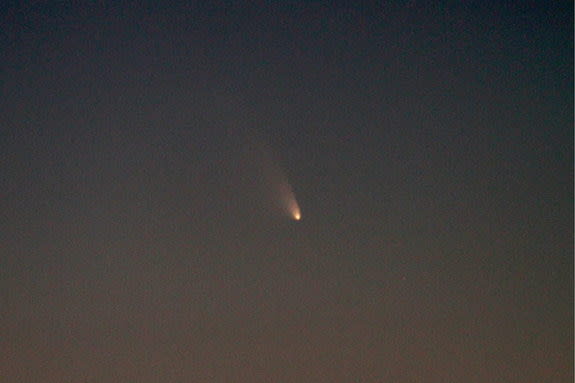
Be in position about an hour after sundown so the sky will be dark enough to see the comet. To find the comet start where the glow from the sunset is brightest and go right (north) about three fields of vision with your binoculars. Then go up from the horizon about one width of the span from your thumb to your pinkie with your fingers spread with your hand held at arm's length.
It took me a few minutes to home in on the comet, so be patient. Once I found it with the binoculars it was easy to go back to in subsequent views. Try as I might, I couldn't make it out with the naked eye, even after I'd found it with the binoculars. It will keep going a little to the north and a little higher in the sky for the next few nights until it is no longer visible.
What I saw was the bright dot, not round but elongated, of the solid part of the comet itself. Then flowing up from from that was the shimmery tail, pointed "up" that is, away from the sun. Go out and see for yourself. These temporary visitors from the outer solar system are truly a wonder of the universe.
Be in position about an hour after sundown so the sky will be dark enough to see the comet. To find the comet start where the glow from the sunset is brightest and go right (north) about three fields of vision with your binoculars. Then go up from the horizon about one width of the span from your thumb to your pinkie with your fingers spread with your hand held at arm's length.
It took me a few minutes to home in on the comet, so be patient. Once I found it with the binoculars it was easy to go back to in subsequent views. Try as I might, I couldn't make it out with the naked eye, even after I'd found it with the binoculars. It will keep going a little to the north and a little higher in the sky for the next few nights until it is no longer visible.
What I saw was the bright dot, not round but elongated, of the solid part of the comet itself. Then flowing up from from that was the shimmery tail, pointed "up" that is, away from the sun. Go out and see for yourself. These temporary visitors from the outer solar system are truly a wonder of the universe.
Wednesday, July 21, 2010
July 20, 1969: One Giant Leap
Forty-one years ago my family and I sat transfixed before our television set and watched history being made. On July 20, 1969 we saw Neil Armstrong, garbed in a bulky protective suit, descend a short ladder and become the first human to set foot on an alien world. "That's one small step for (a) man, one giant leap for mankind," he memorably stated.
Goose bumps caused the hair on my fourteen-year-old arms to stand on end. Even at that age I was clearly aware I was witnessing an event of epochal importance. People had dreamed of such a moment since the dawn of human consciousness. It was potentially every bit as significant as Columbus making landfall in the West Indies.
President Kennedy had electrified and mobilized the nation in 1962 by setting a moon landing as a national goal. "We choose to go to the moon. We choose to go to the moon in this decade and do the other things, not because they are easy but because they are hard, because that goal will serve to organize and measure the best of our energies and skills, because that challenge is one that we are willing to accept, one we are unwilling to postpone, and one which we intend to win." See Kennedy's entire speech here.
Three quarters of a million Americans were involved in the space program at its height. We were inspired because we are adventurers and explorers at heart. Our more distant forebears explored and settled these continents; our more recent ones gave up kin and country to strike out on their own in search of new opportunity. We were inspired because we love a challenge, and the tougher the better. We were inspired because we love competition. The rival superpower, the Soviet Union, had beaten us off the mark into space and we were not to be outdone, not by anyone, and especially not by them. In those days, with triumph over the Great Depression and victory in World War II still fresh in the memories of all Americans over 30 and that can-do attitude imbued into us, their offspring, there was no doubt in anyone's mind we could accomplish anything we set out to do.
America embraced NASA and the space program for a number of reasons: national pride, scientific curiosity, Cold War one-upsmanship and pioneer spirit among them. It made little difference that a prime unnamed reason was to develop heavy-thrust intercontinental ballistic missiles capable of delivering nuclear Armageddon on Soviet Russia should that prove necessary.
As a spinoff dividend, the scientific advances needed to reach the moon buttressed America's economy and defense technology and kept them foremost in the world for decades to come. These included the computer revolution and major breakthroughs in communications, avionics, metallurgy, plastics, miniaturization, nutrition, optics, electronics and physics, just to name a few.
Besides being a thrilling human adventure, putting Neil Armstrong and Buzz Aldrin on the moon stood also as a supreme national achievement. It showed the kind of relentlessly awesome competence of which a resolute, motivated and unified United States of America is capable. I will remember it with pride for the rest of my life.
Goose bumps caused the hair on my fourteen-year-old arms to stand on end. Even at that age I was clearly aware I was witnessing an event of epochal importance. People had dreamed of such a moment since the dawn of human consciousness. It was potentially every bit as significant as Columbus making landfall in the West Indies.
President Kennedy had electrified and mobilized the nation in 1962 by setting a moon landing as a national goal. "We choose to go to the moon. We choose to go to the moon in this decade and do the other things, not because they are easy but because they are hard, because that goal will serve to organize and measure the best of our energies and skills, because that challenge is one that we are willing to accept, one we are unwilling to postpone, and one which we intend to win." See Kennedy's entire speech here.
Three quarters of a million Americans were involved in the space program at its height. We were inspired because we are adventurers and explorers at heart. Our more distant forebears explored and settled these continents; our more recent ones gave up kin and country to strike out on their own in search of new opportunity. We were inspired because we love a challenge, and the tougher the better. We were inspired because we love competition. The rival superpower, the Soviet Union, had beaten us off the mark into space and we were not to be outdone, not by anyone, and especially not by them. In those days, with triumph over the Great Depression and victory in World War II still fresh in the memories of all Americans over 30 and that can-do attitude imbued into us, their offspring, there was no doubt in anyone's mind we could accomplish anything we set out to do.
America embraced NASA and the space program for a number of reasons: national pride, scientific curiosity, Cold War one-upsmanship and pioneer spirit among them. It made little difference that a prime unnamed reason was to develop heavy-thrust intercontinental ballistic missiles capable of delivering nuclear Armageddon on Soviet Russia should that prove necessary.
As a spinoff dividend, the scientific advances needed to reach the moon buttressed America's economy and defense technology and kept them foremost in the world for decades to come. These included the computer revolution and major breakthroughs in communications, avionics, metallurgy, plastics, miniaturization, nutrition, optics, electronics and physics, just to name a few.
Besides being a thrilling human adventure, putting Neil Armstrong and Buzz Aldrin on the moon stood also as a supreme national achievement. It showed the kind of relentlessly awesome competence of which a resolute, motivated and unified United States of America is capable. I will remember it with pride for the rest of my life.
Monday, July 5, 2010
Why Won't Conservatives Accept Global Warming?
I have been mystified by the resistance of many conservatives to the scientific consensus on global warming. The data is overwhelming that the overall temperature of the earth is rising and the climate scientists are nearly unanimous in concluding that humans' putting so much carbon dioxide into the atmosphere is the primary cause of it. I've been at a loss to understand why intelligent people who do not argue with the idea that they need to cut down on cholesterol to reduce their chances of heart disease become apoplectic to the point of hostility when the atmospheric facts of life are presented to them.
You see, liberals do not regard this as a political issue but a scientific one. You either accept science and reason or you don't. If you don't that puts you in the same category as witch doctors and astrologists, that is, without any credibility. Yet the numbers indicate something else is at work here. 90% of Democrats believe in human-caused temperature rise but only 30% of Republicans do. Why the difference by ideology?
I suspect the Republican reluctance to accept the findings is indeed based in ideology, and the ideology of limited government. In the cholesterol example I gave earlier, the individual can do something decisive about the problem. But the planetary climate change problem would take massive international action and include requirements and mandates on all kinds of products, processes and activities. And that is precisely the kind of approach modern American conservatives hate. I feel that lies at the heart of conservative resistance to science on this one.
You see, liberals do not regard this as a political issue but a scientific one. You either accept science and reason or you don't. If you don't that puts you in the same category as witch doctors and astrologists, that is, without any credibility. Yet the numbers indicate something else is at work here. 90% of Democrats believe in human-caused temperature rise but only 30% of Republicans do. Why the difference by ideology?
I suspect the Republican reluctance to accept the findings is indeed based in ideology, and the ideology of limited government. In the cholesterol example I gave earlier, the individual can do something decisive about the problem. But the planetary climate change problem would take massive international action and include requirements and mandates on all kinds of products, processes and activities. And that is precisely the kind of approach modern American conservatives hate. I feel that lies at the heart of conservative resistance to science on this one.
Saturday, April 10, 2010
Science vs. Superstition: 400 Years Later
In 1610 Galileo Galilei turned his telescope to the night sky and immediately began poking holes in the astronomical misconceptions of his day. The moon was not smooth, but had mountains and craters. The earth was not the only body around which others revolved; he could see four moons around Jupiter, for instance. The sun was not an unblemished ball of light; it had dark spots on its surface and irregular prominences projecting out from it. Saturn was surrounded by a giant ring. The planets appeared to revolve around the sun, not the earth, as religious authorities insisted. Copernicus was therefore right and Aristotle and the Church were wrong. Such heresies would not be tolerated for long. Galileo soon found himself under torture and on trial for his life.
These were the opening volleys in a historical showdown that has come to be known as the Scientific Revolution. During the crucial seventeenth century, the forces of logic, fact and reality slowly gained the upper hand over the dead hand of superstition, dogma and vested interest. The effort culminated in 1687 with Isaac Newton's axial Principia Mathematica, which formulated the laws of motion and whose calculations unveiled the workings of universal gravitation. Science, logic and mathematics had laid bare the machinery of the physical universe. Inquisitors, witch burners and Luddites would fight diminishing rear-guard actions against reason in the years ahead, but their following shrank year by year as the wonders and mysteries of the world revealed their secrets to the scientific method and the functional marvels it spawned, including in turn the steam engine, electricity, powered flight, antibiotics and space travel.
Now, remarkably, exactly 400 years since the Scientific Revolution began, it is once again coming under increasing attack, at least in the United States of America. Here, the fact and reality-based worldview appears to be losing ground to a combination of vested interest group advertising and wishful-thinking know-nothingism. My regional newspaper had a guest opinion piece today by a scientist that may seem poignant if it is remembered sometime in the future. UC Merced Associate Professor of Geography and Environmental Engineering Anthony L. Westerling, writing in the Fresno Bee, told of a symposium his university will be sponsoring beginning Monday on "the dramatic disparity between perceptions by the public and the scientific community" regarding climate change.
Though the evidence gathered by science demonstrates that, "the conclusion that the observed warming can only be explained by human causes has only strengthened over time," he reports that "numerous polls" including "a Gallup poll made public last month found that a large and increasing number of Americans believe that the seriousness of climate change has been exaggerated, that it will not post a serious threat within their lifetimes, and that it is not caused by humans." He backs this up with data, of course, as scientific types tend to do, even saying that the by-now standard skeptic theory that the sun is heating up is dead wrong, that instead "variations in the energy from the sun would have produced a decrease in temperature were it not for the warming caused by human actions."
It will be interesting to see what the Sigma Xi Research Society is able to come up with in the symposium this coming week. Climatologists will speak on the data, its relation to the recently held Copenhagen Diagnosis will be explained, others will discuss popular misconceptions that hinder the public's understanding of science and another seminar will "address how special interests and the media have contributed to confusion" about the issue. In case you can make it, it will take place in UC Merced's Lakireddy Auditorium. The Monday session goes from 1:30 to 5:00 P.M. It is free of charge and will be open to the public.
These were the opening volleys in a historical showdown that has come to be known as the Scientific Revolution. During the crucial seventeenth century, the forces of logic, fact and reality slowly gained the upper hand over the dead hand of superstition, dogma and vested interest. The effort culminated in 1687 with Isaac Newton's axial Principia Mathematica, which formulated the laws of motion and whose calculations unveiled the workings of universal gravitation. Science, logic and mathematics had laid bare the machinery of the physical universe. Inquisitors, witch burners and Luddites would fight diminishing rear-guard actions against reason in the years ahead, but their following shrank year by year as the wonders and mysteries of the world revealed their secrets to the scientific method and the functional marvels it spawned, including in turn the steam engine, electricity, powered flight, antibiotics and space travel.
Now, remarkably, exactly 400 years since the Scientific Revolution began, it is once again coming under increasing attack, at least in the United States of America. Here, the fact and reality-based worldview appears to be losing ground to a combination of vested interest group advertising and wishful-thinking know-nothingism. My regional newspaper had a guest opinion piece today by a scientist that may seem poignant if it is remembered sometime in the future. UC Merced Associate Professor of Geography and Environmental Engineering Anthony L. Westerling, writing in the Fresno Bee, told of a symposium his university will be sponsoring beginning Monday on "the dramatic disparity between perceptions by the public and the scientific community" regarding climate change.
Though the evidence gathered by science demonstrates that, "the conclusion that the observed warming can only be explained by human causes has only strengthened over time," he reports that "numerous polls" including "a Gallup poll made public last month found that a large and increasing number of Americans believe that the seriousness of climate change has been exaggerated, that it will not post a serious threat within their lifetimes, and that it is not caused by humans." He backs this up with data, of course, as scientific types tend to do, even saying that the by-now standard skeptic theory that the sun is heating up is dead wrong, that instead "variations in the energy from the sun would have produced a decrease in temperature were it not for the warming caused by human actions."
It will be interesting to see what the Sigma Xi Research Society is able to come up with in the symposium this coming week. Climatologists will speak on the data, its relation to the recently held Copenhagen Diagnosis will be explained, others will discuss popular misconceptions that hinder the public's understanding of science and another seminar will "address how special interests and the media have contributed to confusion" about the issue. In case you can make it, it will take place in UC Merced's Lakireddy Auditorium. The Monday session goes from 1:30 to 5:00 P.M. It is free of charge and will be open to the public.
Monday, December 29, 2008
Teen Abstinence Pledges Have No Effect
The first sentence of the story sums it up pretty neatly. "Teenagers who pledge to remain virgins until marriage are just as likely to have premarital sex as those who do not promise abstinence and are significantly less likely to use condoms and other forms of birth control when they do, according to a study out today."
Janet Rosenbaum, who conducted the study for the Johns Hopkins Bloomberg School of Public Health concluded, "Taking a pledge doesn't seem to make any difference at all in any sexual behavior. But it does seems to make a difference in condom use and other forms of birth control that is quite striking." This striking difference is a 10-point reduction in taking precautions against pregnancy or sexually transmitted diseases. You can see the Washington Post story on it here.
The results will provide fodder for the debate about whether to continue the Bush Administration's concentration on "abstinence only" education programs, which currently enjoy $176 million in federal support. This is a cornerstone issue to the current occupant's fundamentalist base of supporters. They believe that talking about sex makes teenagers more likely to engage in it, as does talking about ways to have sex and not get pregnant or contract STDs. As usual, studies like these do not change their views, which tend to be faith-based and therefore impervious to fact and logic.
If the same number of teens will have sex whether they are taught a comprehensive or an abstinence-only curriculum, then withholding information that would reduce unwanted pregnancies and save lives seems particularly shortsighted and cruel. More studies should be done to determine whether the Johns Hopkins results can be confirmed. If so, then abstinence only programs should be left to the organizations that want to promote them-without public support.
Good comprehensive curricula clearly point out the common emotional and psychological repercussions of teen sex, as well as the risks of pregnancy and venereal diseases and their effects. Armed with this, if the young people still want to have sex they deserve to know the choices of safeguards they can employ. To think and teach otherwise is naive in the extreme--and dangerous.
Janet Rosenbaum, who conducted the study for the Johns Hopkins Bloomberg School of Public Health concluded, "Taking a pledge doesn't seem to make any difference at all in any sexual behavior. But it does seems to make a difference in condom use and other forms of birth control that is quite striking." This striking difference is a 10-point reduction in taking precautions against pregnancy or sexually transmitted diseases. You can see the Washington Post story on it here.
The results will provide fodder for the debate about whether to continue the Bush Administration's concentration on "abstinence only" education programs, which currently enjoy $176 million in federal support. This is a cornerstone issue to the current occupant's fundamentalist base of supporters. They believe that talking about sex makes teenagers more likely to engage in it, as does talking about ways to have sex and not get pregnant or contract STDs. As usual, studies like these do not change their views, which tend to be faith-based and therefore impervious to fact and logic.
If the same number of teens will have sex whether they are taught a comprehensive or an abstinence-only curriculum, then withholding information that would reduce unwanted pregnancies and save lives seems particularly shortsighted and cruel. More studies should be done to determine whether the Johns Hopkins results can be confirmed. If so, then abstinence only programs should be left to the organizations that want to promote them-without public support.
Good comprehensive curricula clearly point out the common emotional and psychological repercussions of teen sex, as well as the risks of pregnancy and venereal diseases and their effects. Armed with this, if the young people still want to have sex they deserve to know the choices of safeguards they can employ. To think and teach otherwise is naive in the extreme--and dangerous.
Friday, November 14, 2008
Stunning Astronomical Discovery
When I was a boy nothing fired my imagination more than the space program. My mother got me up before dawn in California so I could watch Alan Shepherd, Virgil Grissom, John Glenn and the others of our first astronauts "blast off" into the great beyond. Now, remarkable news has just come in of the first visual image of a planet orbiting a star other than our sun. This achievement owes its realization to the amazing capabilities of the Hubble Space Telescope and some remarkable persistence by the astronomical team on the job.
The star Fomalhaut is a main sequence white dwarf star, similar to our sun, about 25 light years from Earth. By astronomical measures that is pretty close to our own neighborhood, though in more familiar terms it is a long way- over 150 trillion miles. As early as the 1980s Fomalhaut was observed to have a gas and debris disc around it, evidence of an early solar system still in formation. It is now thought the star and its system may only be 200 million years old. That is mere infancy compared to the 4.6 billion year age of our own system.
A planet has now been identified even in visual light. It is about three times the mass of Jupiter, orbiting over 10.7 billion miles from its star. That is much farther away than Pluto is from our sun. It is so far away that one orbit around Fomalhaut takes 872 years. The planet's gravity is apparently creating a gap in the disc, shepherding matter out of it. Click here for an article from NASA and the actual picture of Fomalhaut b, the newly discovered planet's tentative designation.
As our capacities improve it seems only a matter of time before we discover another world that supports life, if one exists relatively close to us. Such a planet would be easily identifiable from the spectrograph of an atmosphere that contained a lot of free oxygen and a replenishing quantity of methane. These characteristics would almost certainly be the byproducts of biological activity.
Given the progress of our detection systems and the nearly infinite number of stars and planets it seems increasingly likely that such a world will be found, even within the next few years. It will be interesting to say the least how such a discovery might affect such fields as philosophy, science, art and literature here on our little blue planet.
The star Fomalhaut is a main sequence white dwarf star, similar to our sun, about 25 light years from Earth. By astronomical measures that is pretty close to our own neighborhood, though in more familiar terms it is a long way- over 150 trillion miles. As early as the 1980s Fomalhaut was observed to have a gas and debris disc around it, evidence of an early solar system still in formation. It is now thought the star and its system may only be 200 million years old. That is mere infancy compared to the 4.6 billion year age of our own system.
A planet has now been identified even in visual light. It is about three times the mass of Jupiter, orbiting over 10.7 billion miles from its star. That is much farther away than Pluto is from our sun. It is so far away that one orbit around Fomalhaut takes 872 years. The planet's gravity is apparently creating a gap in the disc, shepherding matter out of it. Click here for an article from NASA and the actual picture of Fomalhaut b, the newly discovered planet's tentative designation.
As our capacities improve it seems only a matter of time before we discover another world that supports life, if one exists relatively close to us. Such a planet would be easily identifiable from the spectrograph of an atmosphere that contained a lot of free oxygen and a replenishing quantity of methane. These characteristics would almost certainly be the byproducts of biological activity.
Given the progress of our detection systems and the nearly infinite number of stars and planets it seems increasingly likely that such a world will be found, even within the next few years. It will be interesting to say the least how such a discovery might affect such fields as philosophy, science, art and literature here on our little blue planet.
Subscribe to:
Posts (Atom)