I confess it was with no great sadness that I heard of the passing of Supreme Court Justice Antonin Scalia this past weekend. Known as the intellectual linchpin of the tribunal's conservative wing, Justice Scalia took great pains to protect the rights of corporations as if they were people but paid scant attention to protecting the rights of actual people. President Obama has announced he will fulfill his constitutional duty under Article II to nominate a successor. Now we will find out whether the Republican majority in the Senate will go through with its threats to refuse to exercise its constitutional mandate to vote to confirm or deny the president's choice. If so, their political flackery will have reached unprecedented heights, even for them. Such a course would likely hurt them in this November's election.
Scalia voted with the 5-4 majority to stop the 2000 Florida recount, awarding the presidency to George W. Bush without the inconvenience of an accurate vote tabulation. He was the similarly deciding vote in cases that overturned forty years of precedents and gave corporations the same rights as human beings, the Citizens United and McCutcheon rulings. He voted to gut the enforcement provisions of the Voting Rights Act, another 5-4 ruling that has been used, through GOP gerrymandering, to once again disenfranchise black voting strength across the South. In his opinion the Fourteenth Amendment ("No state shall...deny to any person within its jurisdiction the equal protection of the laws.") does not guarantee equal rights for women and LGBT Americans. He stated "In 1868, when the 39th Congress was debating and ultimately proposing the 14th Amendment, I don't think anybody would have thought that equal protection applied to sex discrimination, or certainly not to sexual orientation. So does that mean that we've gone off in error by applying the 14th Amendment to both? Yes, yes. Sorry to tell you that." (Source of Scalia quote.) It does not sadden me that such a jurist is no longer on the bench of the nation's highest court.
Within hours of news of Scalia's death, Senate Majority Leader Mitch McConnell announced that no vote would be taken on any successor until after the November election, that a new president should make the selection. McConnell's gambit would deny President Obama the opportunity to name a progressive jurist, hoping for a Republican victory to allow conservatives to maintain their majority on the tribunal. Obama, however, in his own statement, promised to exercise his constitutional responsibility to fill the vacancy, and called on the Senate to follow theirs, to vet the nominee and have a vote. Here are the political considerations. If the Republicans dig in their heels and refuse action they will succeed in ginning up their own base. Committed conservatives would be more motivated to come out and vote for President to prevent a liberal Supreme Court majority. But the converse is also true. Democrats would make this a major issue, firing up their own base to show up and ensure a new Court more friendly to consumers and minorities than corporations and bigots. The deciding factor would be with independents. I feel the maneuver would push most independents in the Democrats' direction. If Obama were to nominate someone who has been already unanimously confirmed by the whole Senate for a lower Court position, independents would see the Republican tactic for the partisan political power play it is, hurting them with the undecideds and helping Democrats in close congressional elections and in battleground states if the presidential election is close. That's why we are already starting to see some GOP senators back away from the scorched earth approach. Look for the next three weeks to tell the story. By then the President will make his nomination and the ball will be in McConnell's "court," so to speak.
Wednesday, February 17, 2016

Sunday, February 7, 2016
Three Contests Crucial to Democratic Nomination Battle
The Democratic presidential contest is now down to a one-on-one contest between Hillary Clinton and Bernie Sanders. In Iowa's caucuses Clinton's careful attention to organization, learned in a bitter lesson eight years ago against Barack Obama and John Edwards, squared off against Sanders's enthusiasm factor. The collision produced the closest thing to a draw, with Clinton claiming bragging rights with a win of two-tenths of a percentage point and a 23-21 edge in delegates won. The basic takeaway is that this is a real horse race--Bernie will not go gentle into the night. And though Secretary Clinton has a preponderance of national strength, Senator Sanders has a launching pad coming up and a message that resonates with the Democratic base. The odds still favor Clinton. Yet Sanders is getting plenty of money to compete from small contributions. A powerful early win for him could seriously deflate her electability argument and give the ardent transplanted Brooklynite a path to victory. But strong rebounds by Clinton in South Carolina and Nevada could set up a near-sweep for her on Super Tuesday and put the nomination within her grasp.
The dynamic in play is that Sanders has tapped into the issue that resonates most strongly with the Democratic base: income inequality, and an influence and campaign finance system that most believe acts to rig the economy and opportunity to the benefit of corporations and the wealthy few. Clinton has the overwhelming backing of the Democratic Party and its office holders. She has the competence edge, with an encyclopedic grasp of every issue, foreign and domestic. Both are liberal, or progressive in wanting to protect civil rights and programs that help average Americans. Sanders is clearly the more liberal, though, wanting to extend these programs much farther than she proposes. His hurdle is moving past being a one-issue candidate. Hers is providing a compelling vision for her candidacy beyond experience.
Here's what's in store in the primary calendar: This Tuesday February 9 is the New Hampshire primary. 32 delegates are at stake, and Sanders is odds on to win big. In a New England state that borders Bernie's Vermont, the poll averages read Sanders 54.6 and Clinton 40.1. That's a 14.5% lead for the Bern. The trend has leveled off, though. Sanders' lead went from 6.7% on January 17 up to 19.5%, but now has begun to float back a bit given the last couple of surveys. The gap has narrowed 5.1% in the last 5 days. If Hillary can get this back to single digits by Tuesday it will help blunt his momentum.
The next contest is South Carolina on Saturday, February 20. It's a primary vote with 59 delegates at stake. This state is supposed to be a Clinton firewall to break Sanders' momentum if he wins New Hampshire. The last surveys give Clinton an overwhelming lead by an average margin of almost 30 points, 62% to 32.5%. The majority of Democratic voters in South Carolina are black, a demographic that polls strongly loyal to Secretary Clinton nation-wide. There are two considerations that might change this calculus. First, there hasn't been any recent polling there. The most up-to-date ones were completed January 21 and 23. Second, if Sanders pulls off a big win in the New Hampshire primary it's not clear how damaging that might be to Hillary's overall national position with voters. She still holds a commanding fourteen-point lead across America, 50% to 36%, but no one is sure if or by how much that might erode if a sharp blow to her inevitability case is inflicted in the Granite State.
Presuming a strong Clinton win in South Carolina, the next battle will be in Nevada, which holds caucuses Saturday February 27 to allot the Silver State's 43 delegates. Nevada is 27.5% Latino and 9% African-American, numbers that should help the Clinton cause. The numbers we have gave Hillary a big 19.5% lead there (50% to 30.5%), but they are old. There haven't been any polls there since December 27. I think Nevada will be of great significance. If Clinton thumps the Bern it will begin to deflate the excitement and hope of his candidacy. If he wins, it will fuel the passion of his supporters and the impression that Hillary's star is on the decline.
Only three days later comes "Super Tuesday," March 1, when 12 Democratic contests are scheduled. These include 7 in the South, where Hillary ought to be favored. These are Alabama, Arkansas, Georgia, Oklahoma, Tennessee, Texas and Virginia. There are 4 in the North, where Bernie's chances are likely to be better: Vermont, Colorado, Massachusetts and Minnesota. There will also be a caucus in American Samoa. By the end of the evening of Tuesday, March 1, the shape of the Democratic race and the probable winner will almost certainly be known.
The dynamic in play is that Sanders has tapped into the issue that resonates most strongly with the Democratic base: income inequality, and an influence and campaign finance system that most believe acts to rig the economy and opportunity to the benefit of corporations and the wealthy few. Clinton has the overwhelming backing of the Democratic Party and its office holders. She has the competence edge, with an encyclopedic grasp of every issue, foreign and domestic. Both are liberal, or progressive in wanting to protect civil rights and programs that help average Americans. Sanders is clearly the more liberal, though, wanting to extend these programs much farther than she proposes. His hurdle is moving past being a one-issue candidate. Hers is providing a compelling vision for her candidacy beyond experience.
Here's what's in store in the primary calendar: This Tuesday February 9 is the New Hampshire primary. 32 delegates are at stake, and Sanders is odds on to win big. In a New England state that borders Bernie's Vermont, the poll averages read Sanders 54.6 and Clinton 40.1. That's a 14.5% lead for the Bern. The trend has leveled off, though. Sanders' lead went from 6.7% on January 17 up to 19.5%, but now has begun to float back a bit given the last couple of surveys. The gap has narrowed 5.1% in the last 5 days. If Hillary can get this back to single digits by Tuesday it will help blunt his momentum.
The next contest is South Carolina on Saturday, February 20. It's a primary vote with 59 delegates at stake. This state is supposed to be a Clinton firewall to break Sanders' momentum if he wins New Hampshire. The last surveys give Clinton an overwhelming lead by an average margin of almost 30 points, 62% to 32.5%. The majority of Democratic voters in South Carolina are black, a demographic that polls strongly loyal to Secretary Clinton nation-wide. There are two considerations that might change this calculus. First, there hasn't been any recent polling there. The most up-to-date ones were completed January 21 and 23. Second, if Sanders pulls off a big win in the New Hampshire primary it's not clear how damaging that might be to Hillary's overall national position with voters. She still holds a commanding fourteen-point lead across America, 50% to 36%, but no one is sure if or by how much that might erode if a sharp blow to her inevitability case is inflicted in the Granite State.
Presuming a strong Clinton win in South Carolina, the next battle will be in Nevada, which holds caucuses Saturday February 27 to allot the Silver State's 43 delegates. Nevada is 27.5% Latino and 9% African-American, numbers that should help the Clinton cause. The numbers we have gave Hillary a big 19.5% lead there (50% to 30.5%), but they are old. There haven't been any polls there since December 27. I think Nevada will be of great significance. If Clinton thumps the Bern it will begin to deflate the excitement and hope of his candidacy. If he wins, it will fuel the passion of his supporters and the impression that Hillary's star is on the decline.
Only three days later comes "Super Tuesday," March 1, when 12 Democratic contests are scheduled. These include 7 in the South, where Hillary ought to be favored. These are Alabama, Arkansas, Georgia, Oklahoma, Tennessee, Texas and Virginia. There are 4 in the North, where Bernie's chances are likely to be better: Vermont, Colorado, Massachusetts and Minnesota. There will also be a caucus in American Samoa. By the end of the evening of Tuesday, March 1, the shape of the Democratic race and the probable winner will almost certainly be known.
Saturday, January 30, 2016
Iowa GOP Caucuses: Two Days, Two Questions
Two days out from the Iowa Caucuses there are two main questions to be settled on the Republican side: First, can anybody stop Donald Trump, and second, who will emerge as the "establishment" challenger? The answer to the first is probably not. The answer to the second is likely Marco Rubio. The one thing to keep in mind is that Iowa's Republican caucusers have proven to be truly unpredictable. The political world was shocked when Mike Huckabee came in first in 2008 and Rick Santorum took Hawkeye State laurels in 2012. Both rode those to several state wins and respectable second place finishes in the nomination process. With that caveat out of the way, here's how things stand.
According to an average of state polls of likely GOP caucus goers there are only four candidates with significant support. Trump is at 31%, Ted Cruz 25, Rubio 15 and Ben Carson 9. Jeb Bush is next, but has only 4 percent. The trends are important. Trump stalled for quite awhile but has gained about 5 points the past two weeks. Cruz peaked about three weeks ago with a 4-point lead over Trump but has been edging downward since. Carson led at Halloween and slid enormously until stabilizing at his current level for the past few weeks. Rubio has surged 5 points in the past week.
So what does this portend? Cruz pretty badly could use a win here. It's a state well-suited to his demographics with a big Evangelical population. If Cruz doesn't get the momentum of a win here it's hard to see him winning anywhere anytime soon, maybe until Texas on Super Tuesday, March 1. But by then he may be on the severe downswing. No one is quite sure about Trump's turnout machine, so a Cruz win must be considered a possibility. Rubio wins if he finishes third, which it looks pretty strongly like he will. That positions him as the top establishment alternative to the unorthodox Trump and the anti-party Cruz. Carson hardly stays relevant after these caucuses. Expect to see his supporters continue to drift away. Many of them could go to Cruz, but Rubio's been making a play for Carson's religious-oriented backers of late.
One thing is almost certain: Iowa will produce a surprise; it always does. Either Cruz will beat Trump or one of the seeming also-rans (Bush, Chris Christie, John Kasich, Rand Paul, Carly Fiorina Mike Huckabee or Rick Santorum) will do much better than anticipated and be given a new lease on political life for the time being.
Next week is the New Hampshire Primary. The Tuesday, February 9 vote is mixed, that is, people will be able to vote in either primary's party regardless of their registration. Among those saying they're likely to vote in the New Hampshire Republican contest it's currently no contest for first place, with Trump pulling in 31% in polling averages. He's followed by Kasich at 13, Cruz at 12 and Bush at 11. Rubio has 9 and Christie comes in at 7. That's why Kasich, Bush and Christie will hang in there no matter how badly they do in Iowa--they're all considerably more popular in the Northeast than the farm belt.
But after that the field should winnow considerably. Cruz is the only one within shouting distance of Trump in South Carolina and Nevada, where the campaign moves the next two weeks, and it looks to be between Rubio and Bush to see who will pick up the more moderate mantle by then. Currently South Carolina, February 20 is: Trump 36, Cruz 20, Rubio 13, Carson 9, Bush 10 with no one else above 2 percent. Nevada, on the 23rd, sees Trump at 33, trailed by Cruz with 20, Rubio at 11, and nobody else better than 6.
According to an average of state polls of likely GOP caucus goers there are only four candidates with significant support. Trump is at 31%, Ted Cruz 25, Rubio 15 and Ben Carson 9. Jeb Bush is next, but has only 4 percent. The trends are important. Trump stalled for quite awhile but has gained about 5 points the past two weeks. Cruz peaked about three weeks ago with a 4-point lead over Trump but has been edging downward since. Carson led at Halloween and slid enormously until stabilizing at his current level for the past few weeks. Rubio has surged 5 points in the past week.
So what does this portend? Cruz pretty badly could use a win here. It's a state well-suited to his demographics with a big Evangelical population. If Cruz doesn't get the momentum of a win here it's hard to see him winning anywhere anytime soon, maybe until Texas on Super Tuesday, March 1. But by then he may be on the severe downswing. No one is quite sure about Trump's turnout machine, so a Cruz win must be considered a possibility. Rubio wins if he finishes third, which it looks pretty strongly like he will. That positions him as the top establishment alternative to the unorthodox Trump and the anti-party Cruz. Carson hardly stays relevant after these caucuses. Expect to see his supporters continue to drift away. Many of them could go to Cruz, but Rubio's been making a play for Carson's religious-oriented backers of late.
One thing is almost certain: Iowa will produce a surprise; it always does. Either Cruz will beat Trump or one of the seeming also-rans (Bush, Chris Christie, John Kasich, Rand Paul, Carly Fiorina Mike Huckabee or Rick Santorum) will do much better than anticipated and be given a new lease on political life for the time being.
Next week is the New Hampshire Primary. The Tuesday, February 9 vote is mixed, that is, people will be able to vote in either primary's party regardless of their registration. Among those saying they're likely to vote in the New Hampshire Republican contest it's currently no contest for first place, with Trump pulling in 31% in polling averages. He's followed by Kasich at 13, Cruz at 12 and Bush at 11. Rubio has 9 and Christie comes in at 7. That's why Kasich, Bush and Christie will hang in there no matter how badly they do in Iowa--they're all considerably more popular in the Northeast than the farm belt.
But after that the field should winnow considerably. Cruz is the only one within shouting distance of Trump in South Carolina and Nevada, where the campaign moves the next two weeks, and it looks to be between Rubio and Bush to see who will pick up the more moderate mantle by then. Currently South Carolina, February 20 is: Trump 36, Cruz 20, Rubio 13, Carson 9, Bush 10 with no one else above 2 percent. Nevada, on the 23rd, sees Trump at 33, trailed by Cruz with 20, Rubio at 11, and nobody else better than 6.
Sunday, January 24, 2016
Two Book Appearances This Week
I'll be making book appearances on Tuesday and Wednesday this week, and you are invited!
Tuesday will be on the College of the Sequoias Visalia campus, at 915 S. Mooney Boulevard in the conference room Hospital Rock 133. Here's a link to a campus map. We'll start at 2:30 pm and go until 3:30. There should be students and faculty present for this one.
Wednesday will be at the monthly meeting of the Visalia Democratic Club. It meets at China Garden Restaurant, 1634 S. Mooney Blvd. The Club gathers in the banquet room, to your left after you enter the front door. Most people order dinner around 6:00 and the meeting gets under way around 6:45.
At both appearances I'll have a power point of highlights of my book, Liberally Speaking: Why Liberalism is Right for America. I'll intersperse a couple of readings and follow up with time for comments and questions. Anthropology Professor Marla Prochnow will moderate the discussion.
I'll certainly be preaching to the choir at the Visalia Democratic Club, highlighting the social, civil rights and economic contributions of liberal leaders and the liberal movement to the advancement of American life.
I'll have books available for purchase and signing at the end of each event.
Tuesday will be on the College of the Sequoias Visalia campus, at 915 S. Mooney Boulevard in the conference room Hospital Rock 133. Here's a link to a campus map. We'll start at 2:30 pm and go until 3:30. There should be students and faculty present for this one.
Wednesday will be at the monthly meeting of the Visalia Democratic Club. It meets at China Garden Restaurant, 1634 S. Mooney Blvd. The Club gathers in the banquet room, to your left after you enter the front door. Most people order dinner around 6:00 and the meeting gets under way around 6:45.
At both appearances I'll have a power point of highlights of my book, Liberally Speaking: Why Liberalism is Right for America. I'll intersperse a couple of readings and follow up with time for comments and questions. Anthropology Professor Marla Prochnow will moderate the discussion.
I'll certainly be preaching to the choir at the Visalia Democratic Club, highlighting the social, civil rights and economic contributions of liberal leaders and the liberal movement to the advancement of American life.
I'll have books available for purchase and signing at the end of each event.
Thursday, January 21, 2016
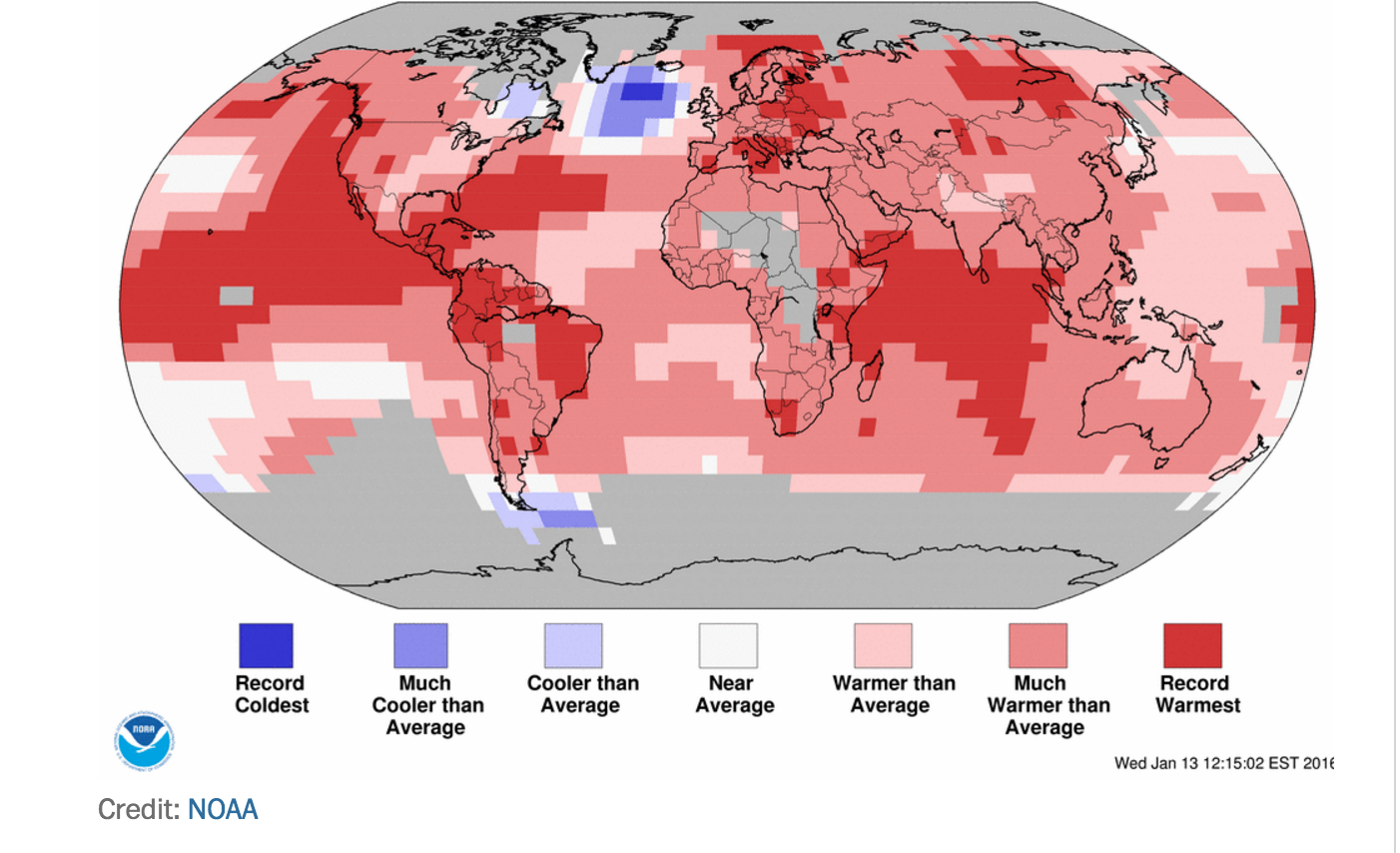
2015 Was Hottest Year On Record
Climate change is back in the news again. The final figures show 2015 was the hottest year on record. By a lot. NASA and the National Oceanic and Atmospheric Administration have both announced it as official. It topped the previous record (2014) by .23 of a degree, almost 1/4 of a degree, when most of the other records have been by a hundredth or two. Here are the global facts in graphic form. It's interesting to note that 1988 set a "hottest" record at the time, and it's not even in the top 20 any more. The recent Paris climate accord shows the world's leaders get it. It's time for the deniers to give it up, and for reasonable people to ignore them. This debate is over.
Thursday, January 14, 2016
Obama SOTU a Masterpiece
President Obama's last State of the Union Address (watch it here) focused primarily on three things: what's been accomplished so far, what will need doing for the future, and areas where the two parties might actually be able to work together to get some things done in the near term. Throughout, the President was able to display the winning personality, oratorical skills and compelling logic that won him two national elections.

Accomplishments included recovery from the worst economy since the Great Depression, the reform of health care, much improved health care for veterans, ending the Cold War with Cuba, forging a climate agreement with nearly 200 nations, getting Iran to stop its nuclear program, and securing "the freedom in every state to marry the person we love." There was much to praise about achievements in the economy. "People who say our economy is in decline are peddling fiction," he said. The U.S. economy is the strongest in the world, with 14 million jobs created during the longest job growth streak in history, autos having their best year ever, oil imports down by 60%, "gas under two bucks a gallon isn't too bad either," more Americans employed in solar now than coal, and 18 million people newly covered with health care. He pointed out that too much of the growth is going to the high earners, and that "regular people don't get bigger paychecks by letting corporations write all the rules."
Obama's look into the future featured four aspects: broadening opportunity and security, making the "tech revolution work for us rather than against us," "how to keep the world safe without being the world's policeman," and how to "make our politics reflect what's best in us, not the worst." The last of these had some clear digs at the type of bombastic and xenophobic demagoguery currently apparent in the Republican presidential campaign field. His words may have little effect with them, but at least he has the satisfaction of being right.
The President thanked Speaker Ryan (behind him, right in the picture above) for helping shepherd a compromise budget through the House, and saluted congress for education reform with the recent No Child Left Behind overhaul. He went on to outline areas where he felt the two parties ought to be able to take action in a bipartisan fashion soon. There is, for example, a growing consensus for a more rehabilitative criminal justice reform. Progress is imminent on help for prescription drug and heroin addiction. And Obama got his best reception when proposing a massive new "moon shot program to eradicate cancer," naming Vice President Joe Biden (back left in the photo above), who lost his son to cancer last year, to head the effort. This was greeting by thunderous roars from both sides of the aisle.
President Obama closed with the theme that brought the then-relatively unknown Illinois State Senator Barack Obama to national prominence in a speech to the 2004 Democratic National Convention that nominated John Kerry. "All this is within our reach. But it will only happen if we can work together...to fix our politics. Democracy requires basic trust among us, and grinds to a halt when we refuse to compromise...A lot of politicians are trapped by the rancor of their base--we must change the system!"
The President pointed to the need for nonpartisan redistricting, reducing the influence of money in the political process and making it easier to vote. He remarked that the only thing he really regrets about his time in office has been his inability to make much of a dent in overcoming the political polarization rampant in government. But he urged the American people to reject cynicism and insist their representatives reflect the people's desire to work together for the common good. His voice has been the right message at the right time in our national story. That it has not been much heard by the Republicans is disappointing, but has not dimmed its righteousness or the inevitability of its triumph in the end if America is to survive. As Dr. Martin Luther King reminded us, "We must learn to live together as brothers or perish together as fools."
Accomplishments included recovery from the worst economy since the Great Depression, the reform of health care, much improved health care for veterans, ending the Cold War with Cuba, forging a climate agreement with nearly 200 nations, getting Iran to stop its nuclear program, and securing "the freedom in every state to marry the person we love." There was much to praise about achievements in the economy. "People who say our economy is in decline are peddling fiction," he said. The U.S. economy is the strongest in the world, with 14 million jobs created during the longest job growth streak in history, autos having their best year ever, oil imports down by 60%, "gas under two bucks a gallon isn't too bad either," more Americans employed in solar now than coal, and 18 million people newly covered with health care. He pointed out that too much of the growth is going to the high earners, and that "regular people don't get bigger paychecks by letting corporations write all the rules."
Obama's look into the future featured four aspects: broadening opportunity and security, making the "tech revolution work for us rather than against us," "how to keep the world safe without being the world's policeman," and how to "make our politics reflect what's best in us, not the worst." The last of these had some clear digs at the type of bombastic and xenophobic demagoguery currently apparent in the Republican presidential campaign field. His words may have little effect with them, but at least he has the satisfaction of being right.
The President thanked Speaker Ryan (behind him, right in the picture above) for helping shepherd a compromise budget through the House, and saluted congress for education reform with the recent No Child Left Behind overhaul. He went on to outline areas where he felt the two parties ought to be able to take action in a bipartisan fashion soon. There is, for example, a growing consensus for a more rehabilitative criminal justice reform. Progress is imminent on help for prescription drug and heroin addiction. And Obama got his best reception when proposing a massive new "moon shot program to eradicate cancer," naming Vice President Joe Biden (back left in the photo above), who lost his son to cancer last year, to head the effort. This was greeting by thunderous roars from both sides of the aisle.
President Obama closed with the theme that brought the then-relatively unknown Illinois State Senator Barack Obama to national prominence in a speech to the 2004 Democratic National Convention that nominated John Kerry. "All this is within our reach. But it will only happen if we can work together...to fix our politics. Democracy requires basic trust among us, and grinds to a halt when we refuse to compromise...A lot of politicians are trapped by the rancor of their base--we must change the system!"
The President pointed to the need for nonpartisan redistricting, reducing the influence of money in the political process and making it easier to vote. He remarked that the only thing he really regrets about his time in office has been his inability to make much of a dent in overcoming the political polarization rampant in government. But he urged the American people to reject cynicism and insist their representatives reflect the people's desire to work together for the common good. His voice has been the right message at the right time in our national story. That it has not been much heard by the Republicans is disappointing, but has not dimmed its righteousness or the inevitability of its triumph in the end if America is to survive. As Dr. Martin Luther King reminded us, "We must learn to live together as brothers or perish together as fools."
Tuesday, January 5, 2016
Obama Does What He Can on Guns
I am often reminded how proud I am to have voted for President Barack Obama twice. He invariably pursues a course trying to serve the needs and interests of the American people as a whole. Today was again one of those days. This morning he addressed the nation to present common sense Executive actions he is taking to enforce the laws and stem the carnage visited upon America by gun violence, a plague that kills some 30,000 Americans every year. These actions fall under four steps.
The first is to tighten up the currently required background check system. Anyone selling firearms must get a license and conduct background checks. This will effectively close the "gun show loophole" problem. In order to facilitate this, the computer system will be upgraded and more workers will be assigned to do the checks. "Anyone selling firearms must get a license and conduct background checks or they will be indicted and prosecuted," the President said.
The second is also about beefing up enforcement. The President directs that the Bureau of Alcohol, Tobacco and Firearms hire and train 200 new agents. The new regulations will require and the additional agents will make possible the more rapid reporting of lost or stolen guns, and empower greater scrutiny and enforcement against offenders convicted of domestic violence.
Step three comprises more resources for mental health. It includes the redirection of $500 million into expanded access for mental health treatment. The Affordable Care Act already provides the framework for delivering these services, and most of the mass shooters of recent years have been seriously mentally disturbed. This directive also requires that such mental health records be reported to those doing the background checks and to state agencies as well.
The fourth area is about requiring safety technology in guns. 500 shooting deaths a year come from accidents, many involving children, and hundreds of murders are committed with stolen guns. The President observed that phones can be protected so the owner's fingerprint is needed for activation. Why not for guns? Through GPS we can locate an iPad wherever it is. Why not a gun? Aspirin tablets have childproof caps. Why not gun safeties or triggers? New regulations will be forthcoming on such specifics.
These are all eminently sensible safeguards, already permitted by law and supported by the vast majority of the American people. The President teared up when going over the list of school shootings, including the first graders at Newtown. "Every time I think about those kids it gets me mad," he explained. He wants more steps too, but frankly admitted they won't be enacted during his presidency by this Congress, and called on citizens to make their voices and votes known. Connecticut, for example, has seen a 40% reduction in gun deaths since enacting 100% mandatory background checks, and Missouri has seen its spike to 50% above the national average since getting rid of theirs.
He concluded, "The gun lobby may hold Congress hostage but they can't hold America hostage. Yes, they are well organized, but we need to be just as organized in defense of our kids. If they know it's going to be harder to win elections if they keep blocking these laws they'll stop blocking these laws, I promise you." CNN will host a Presidential Town Hall on gun issues Thursday at 5:00 P.M. PST.
The first is to tighten up the currently required background check system. Anyone selling firearms must get a license and conduct background checks. This will effectively close the "gun show loophole" problem. In order to facilitate this, the computer system will be upgraded and more workers will be assigned to do the checks. "Anyone selling firearms must get a license and conduct background checks or they will be indicted and prosecuted," the President said.
The second is also about beefing up enforcement. The President directs that the Bureau of Alcohol, Tobacco and Firearms hire and train 200 new agents. The new regulations will require and the additional agents will make possible the more rapid reporting of lost or stolen guns, and empower greater scrutiny and enforcement against offenders convicted of domestic violence.
Step three comprises more resources for mental health. It includes the redirection of $500 million into expanded access for mental health treatment. The Affordable Care Act already provides the framework for delivering these services, and most of the mass shooters of recent years have been seriously mentally disturbed. This directive also requires that such mental health records be reported to those doing the background checks and to state agencies as well.
The fourth area is about requiring safety technology in guns. 500 shooting deaths a year come from accidents, many involving children, and hundreds of murders are committed with stolen guns. The President observed that phones can be protected so the owner's fingerprint is needed for activation. Why not for guns? Through GPS we can locate an iPad wherever it is. Why not a gun? Aspirin tablets have childproof caps. Why not gun safeties or triggers? New regulations will be forthcoming on such specifics.
These are all eminently sensible safeguards, already permitted by law and supported by the vast majority of the American people. The President teared up when going over the list of school shootings, including the first graders at Newtown. "Every time I think about those kids it gets me mad," he explained. He wants more steps too, but frankly admitted they won't be enacted during his presidency by this Congress, and called on citizens to make their voices and votes known. Connecticut, for example, has seen a 40% reduction in gun deaths since enacting 100% mandatory background checks, and Missouri has seen its spike to 50% above the national average since getting rid of theirs.
He concluded, "The gun lobby may hold Congress hostage but they can't hold America hostage. Yes, they are well organized, but we need to be just as organized in defense of our kids. If they know it's going to be harder to win elections if they keep blocking these laws they'll stop blocking these laws, I promise you." CNN will host a Presidential Town Hall on gun issues Thursday at 5:00 P.M. PST.
Subscribe to:
Posts (Atom)